
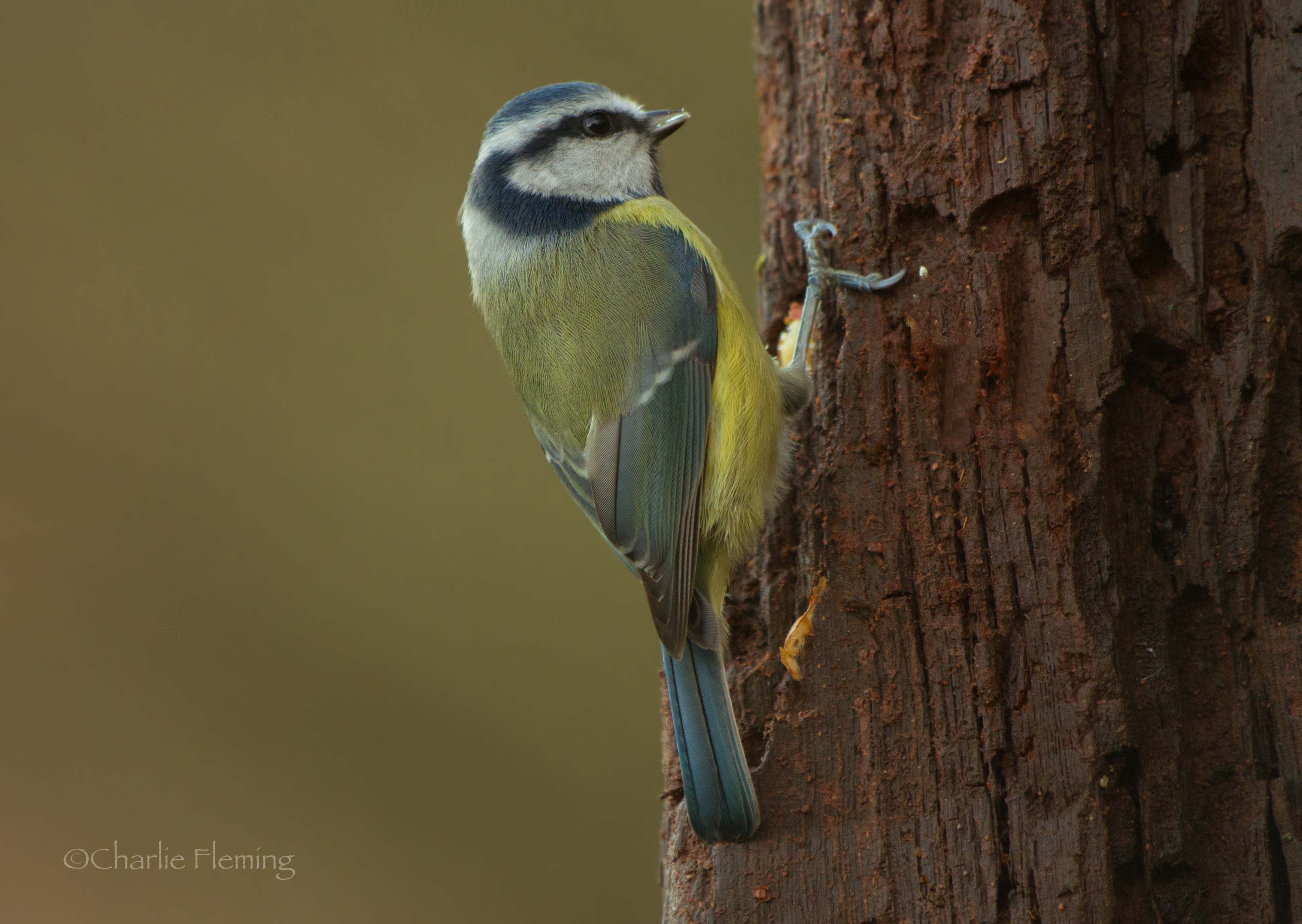
It's interesting to note that the common tit species in the UK and Europe have beaks of slightly different lengths and shapes. This enables them to co-exist in the same habitat and even in the same mixed species flocks. Coal Tits for example, although smaller than Blue Tits, have a longer and proportionally longer beak. The longer beak enables them to probe into deeper cracks and crevices, gleaning the insects that are too deep to be reached by Blue Tits. It was interesting therefore today, to see and photograph a Blue Tit with a deformed beak which was far from hindering the bird, in fact the opposite was the case. I watched it feeding almost like a woodpecker as it was able with it's extended odd looking beak, to probe and "winkle" deep in to cracks in the logs

It's a weird looking bird as you can see. It's not difficult to imagine that this is the way that evolution could occur. Hypothetically, if this bird's beak was a genetical feature and it was gaining an advantage over the other normal beaked birds, the "long-beaked" birds would breed more successfully and eventually after many generations would potentially replace the less successful normal beaked birds. This is exactly the way that evolution occurred in birds. Spending lots of time as I do, observing and photographing birds in a particular location in an almost obsessive way, gives me the opportunity to photograph and observe birds like this. My time is never wasted. When I think of the likes of Darwin, Stanley, Banks, Gould and Gilbert White for example who all studied birds in the 19th century without the aid of not even optics and not even a field guide, then surely someone like me with luxury of 21st century Digital Cameras, fantastic optics and the benefit of the knowledge passed down from all those that went before, can at least try and be observant.
I have been watching the Nuthatches quite closely over the last few weeks. They move around in mixed flocks with the Blue and Coal Tits at this time of the year but will not tolerate another bird on the feed with them, not even one of the same species, the dominant bird always acting aggresively towards all others.




 Wildlife in a Suburban Garden
Leave a reply to Nick Cancel reply