
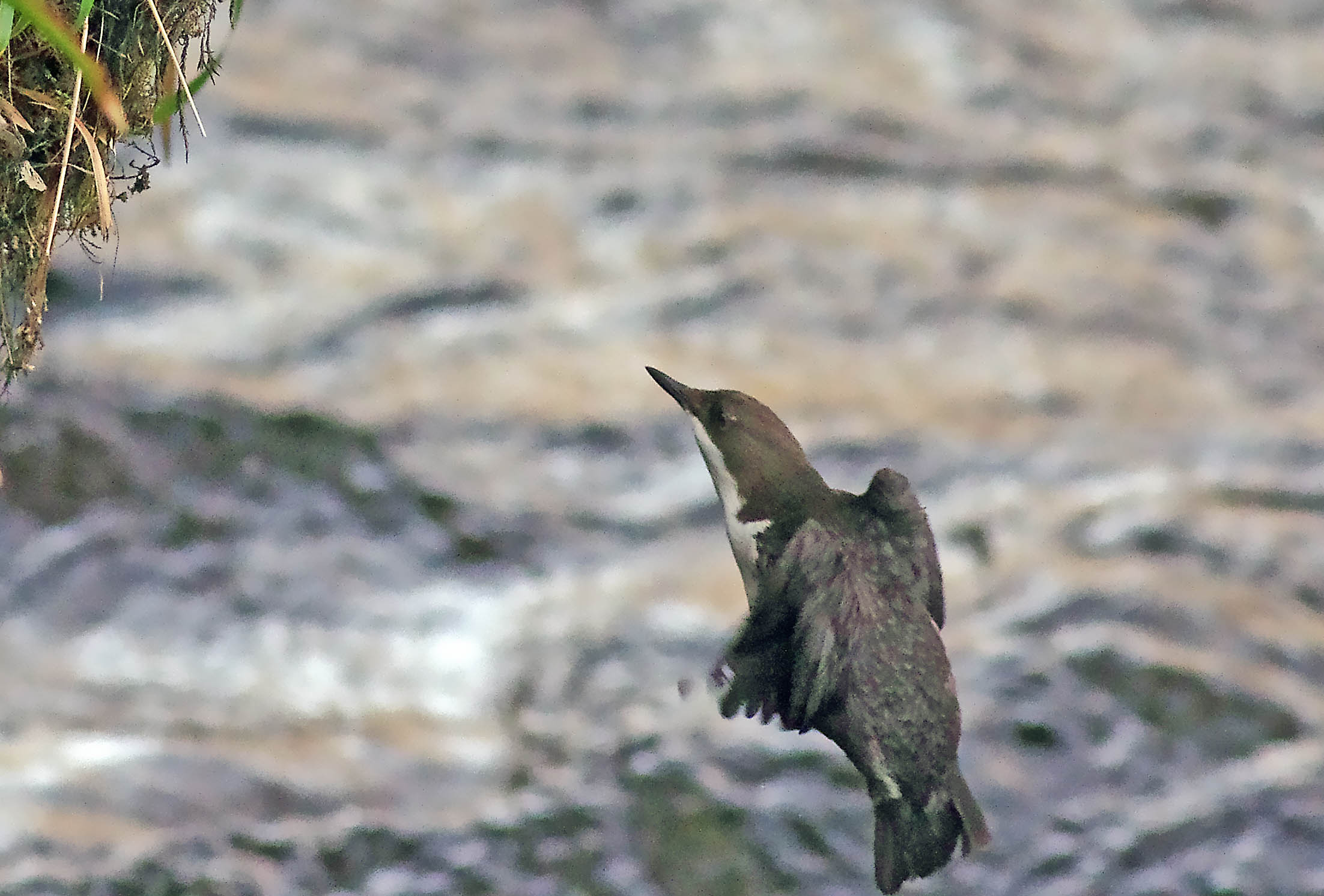
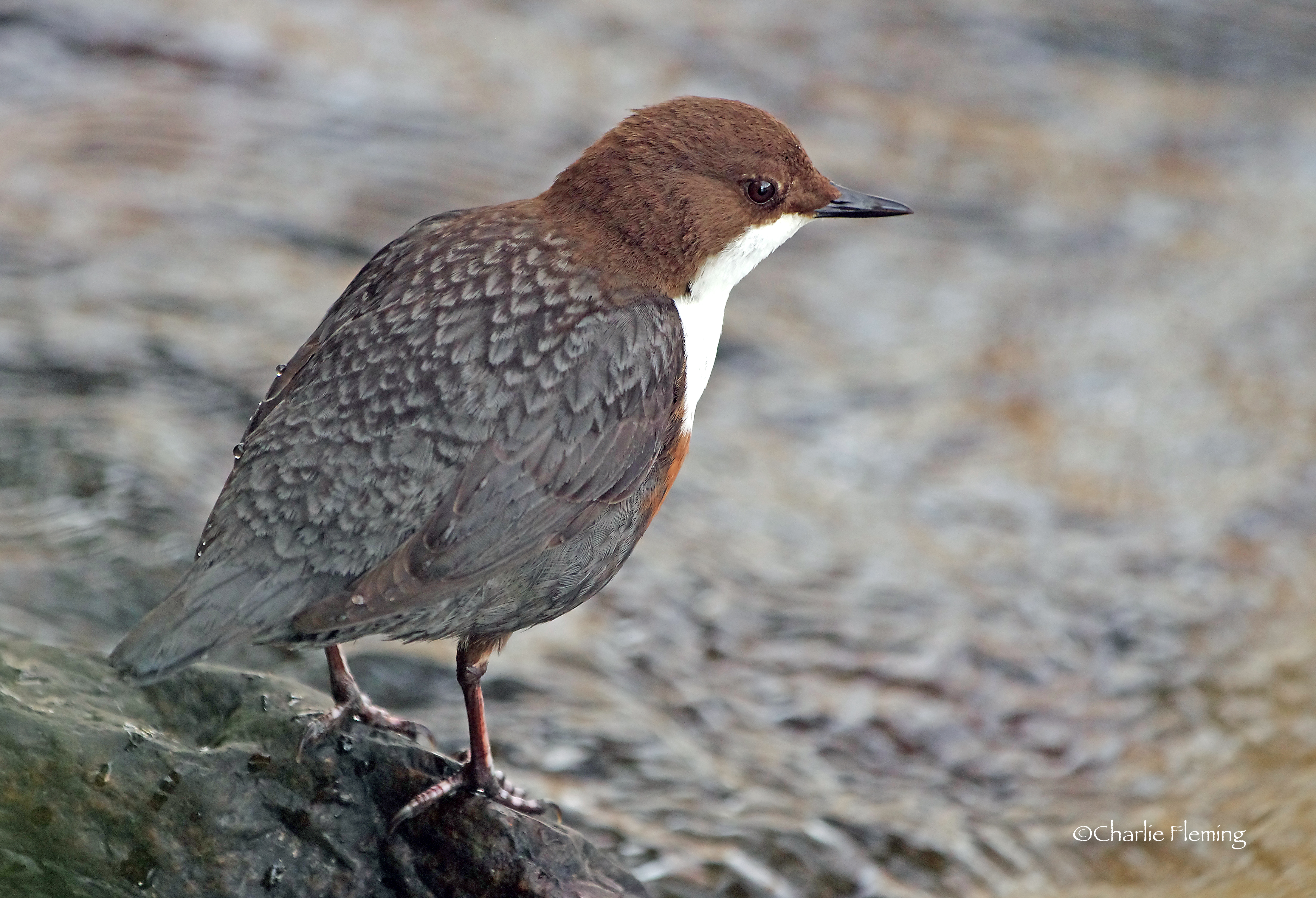
The morning was spent trying to get better photographs of the Dippers flying up in to the nest. I am running out of ideas as to how I can improve now, it just isn't bright enough to get the shot that I am after. In the end, having spent most of the morning trying, I pretty much had to accept defeat and be grateful for what I am seeing and if I manage a decent photo, in-flight, then that's a bonus I suppose. I am learning a lot about breeding Dippers as you would expect and I hope that you (the reader) is learning something as well. It's been interesting to see the behaviour of both birds at this stage, the incubation. The male seems to be almost at a "lose end", sitting around waiting for something to happen, from time to time he goes off to find some food for himself and the female. When he returns to the nest site, I can hear him from quite a distance away, he always calls loudly (and musically) before he lands on one of the nearby boulders. I take this as a signal to the sitting female that he is nearby. After landing he will sing for a minute or two before flying up to the nest, only half entering, and hanging on as he gives the female his offering. Then out he will come after as long as it takes for her to take the food, flopping down in to the water and swimming to the nearby boulder. When he is in the nest he always makes that churring sibilant noise that I heard when they were first building and when they swopped over building duties. This is undoubtedly to get the female's attention so that she is ready to take food from him. It again seems that the male will bring food twice in around 70 minutes, almost like clockwork. However on two occasions as I watched this morning, the female left the nest, presumably to drink, find her own food and defecate. On the first occasion the male was unaware. She was away from the nest for 8 minutes. The second time the male accompanied her and they both flew upstream to feed. Interestingly both birds are prepared to fly several hundred yards away from the nest to feed rather than around the nest area although there does not appear to be a pattern to this feeding behaviour as the male is also quite content to feed in front of the nest. On the second occasion that she vacated the nest I quickly took the opportunity to check the size of the clutch. This is important to know for my BTO nest record card. As refered to previously I am collecting important data about dates of building, egg laying clutch size and the viabilty of the nest as part of the BTO's nest recording scheme, hence my reason for checking the nest. There will be no need for me to check the nest again until around the hatching date when the date of hatching will be recorded. Dippers are said to lay a clutch of four or five eggs, ours have four!


 Wildlife in a Suburban Garden
Leave a reply to Jeff. Cancel reply