
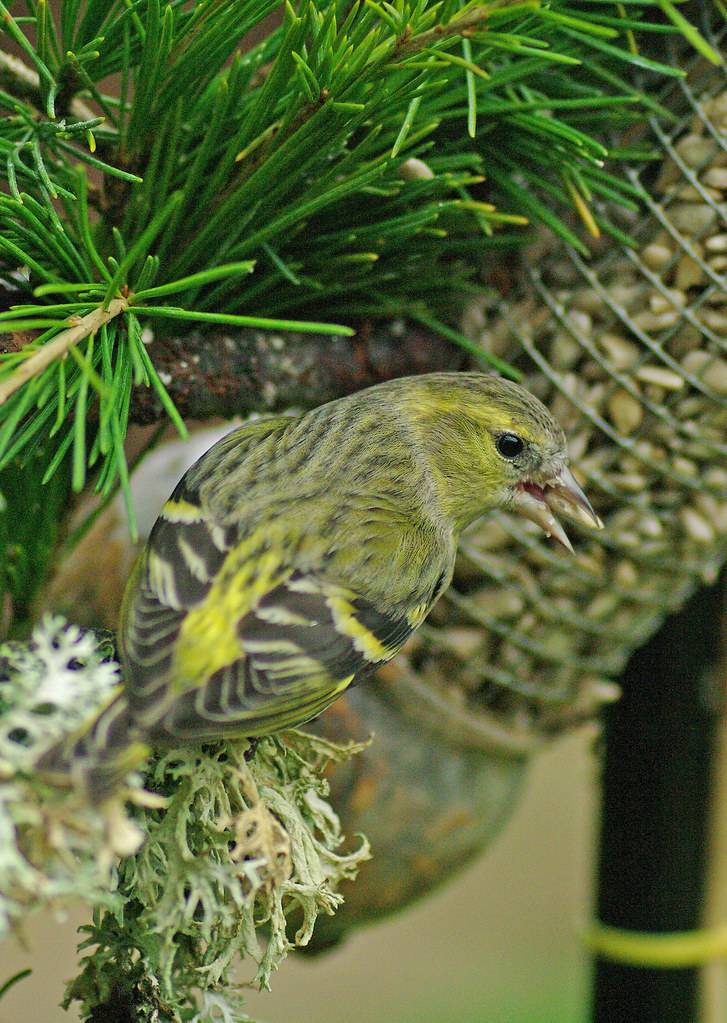
I ought to change the name of my blog to “Siskins in a Suburban Garden” but honestly I can’t resist the draw of taking their photos and as they are just about the most frequent visitors to the feeding station at the moment then what am I to do? I am almost disbelieving that they are so often in the garden now. Today we had several males and more than one female and I still haven’t seen the one with a ring, the first visitor, seen way back in November. I am assuming therefore that we are visited by different birds all the time. It is giving me the chance to experiment with different ways to photograph them. This one (above) was taken with the Tamron macro 1:1 lens I mentioned this the other day. What it enables me to do is stop right down to a small aperture and consequently get a faster shutter speed in low and bad light conditions. The play off is that you have to be literally inches from the subject and then suffer the consequences of a very “narrow” depth of field. You can see that in this photo I focused on the eye which is very sharp and in focus but the tail of the bird which is 3 inches nearer to the camera is out of focus. There we are, a quick explanation of the term “depth of field”. However it is a good sharp lens and gives very good detail in the areas of the picture that are in focus.
You may also notice in the dark areas of the picture there are some grainy effects? This is called noise and is caused by having the camera set at a high sensitivity, but if you you didn’t have the camera set this way then the shutter speed would not be fast enough to capture a sharp image. Birds are almost constantly moving, enough to look blurred if you do not have a fast enough shutter speed.
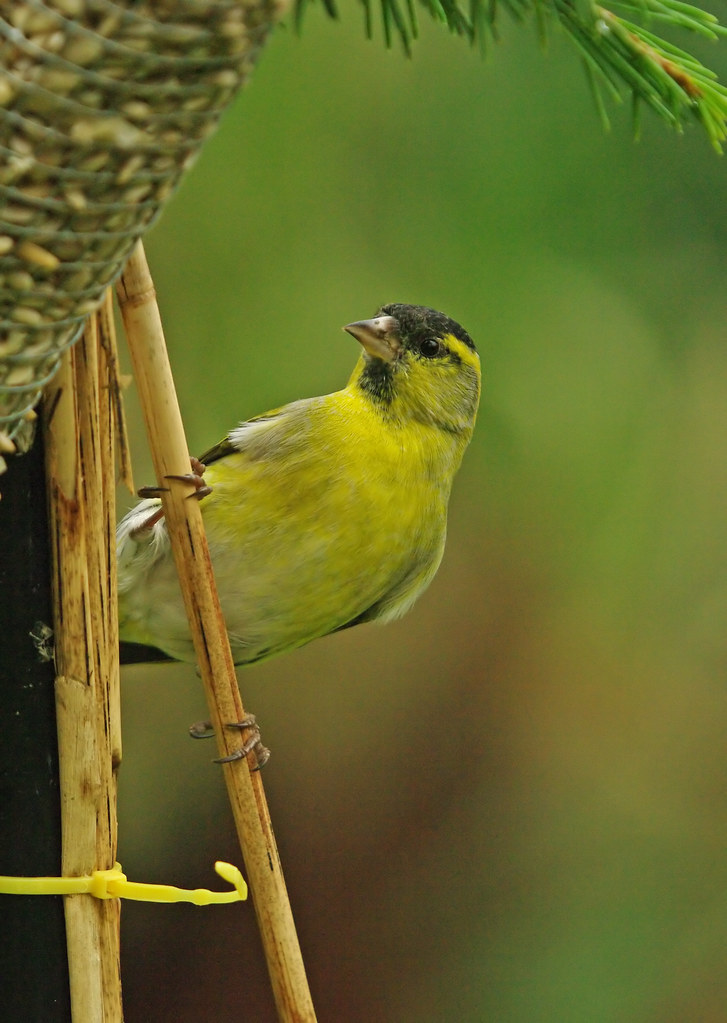
This next image is a male Siskin and taken with a telephoto lens from a little further away. It was slightly brighter when taken, The camera is always going to perform better in brighter light. I still had the camera set to a higher sensitivity setting but I have used a software programme called Neat Image to digitally remove the noise from the background. This programme is a “plug-in” that is used in conjunction with Adobe Photoshop Elements and works well but sometimes it can “smooth” the detail of the bird which is just what you don’t want so I use it sparingly. In this shot you can see the annoying yellow cable tie that I used to attach the reed stem to a fishing bank stick. These bank sticks are useful because you can attach various new bits of foliage to them and vary the background and “props” used in your pictures.
You may remember the ringing session we had in the garden on the 15 January? We successfully ringed a Robin and a Blue Tit. Today we had a Blue Tit on the feeder and it was the bird rung last month. This is interesting and proves obviously that this bird has been around for at least a month. Hardly ground breaking science but interesting never the less. Unfortunately you can’t see his ring in the shot here but I did get a poor photo of him ….. yes I know he is a male, that shows the ring very clearly.

One response to “Siskins in a Suburban Garden”
-
Hi
I’ve just discovered your blog.
Wonderful photo’s. I’ve also begun experimenting with a Tamron macro recently. What you don’t say is how you manage to get so close to the birds to achieve such great photo’s (are you in a hide or do you simply good at standing very still!)
I’m busy blogging my garden’s wildlife in Oxfordshire (http://lifeonanoxfordlawn.blogspot.com/) – delighted to meet a natural hisotry lover.LikeLike

About the Podcast
Welcome to The Houseplant Podcast, your ultimate guide to houseplants! Join us as we explore the wonders and importance of plants in our lives.
 Wildlife in a Suburban Garden
Leave a comment