
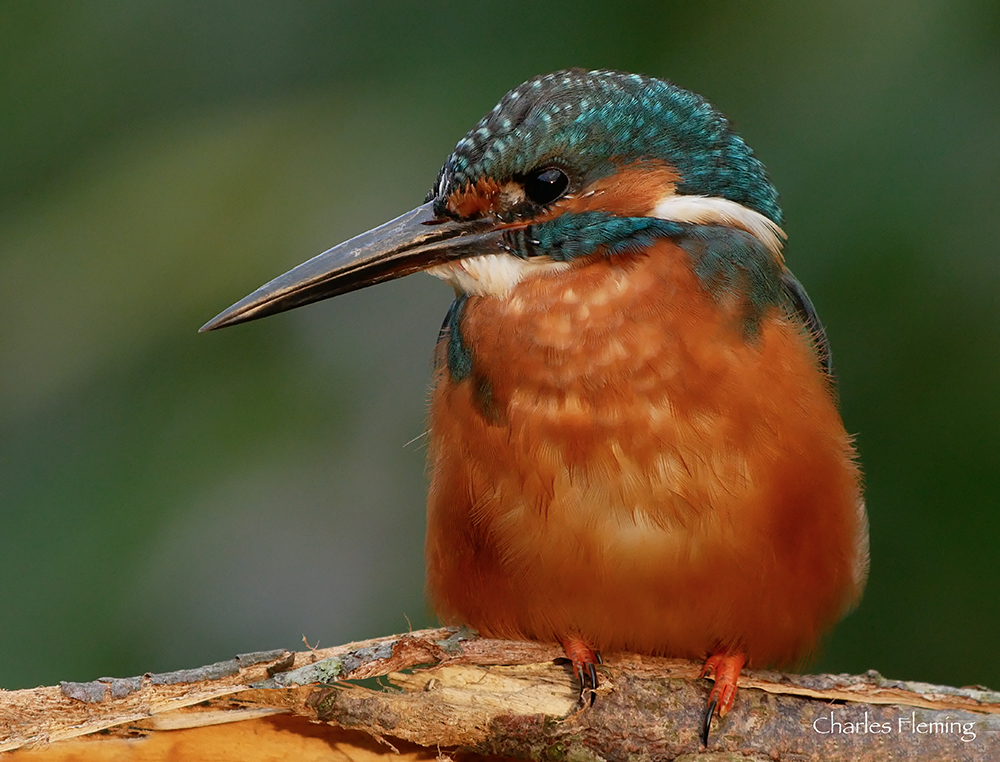
I have taken hundreds and hundreds of Kingfisher photographs and don't find it too difficult to get close enough to take a good photograph. In my opinion, being close to your subject is probably the most important factor in getting an unimpressive image. It's also a case of knowing your subject and having an understanding of behaviour. Then, its also about having the confidence to waste a few hours while you wait for a bird to come close. You won't find it easy to sneak up on a Kingfisher, in fact you can pretty much forget that as a plan. However, if you you know that Kingfishers are using a particular watercourse then because of their territorial nature it is relatively simple to stake out the water and by sitting still and under cover for several hours, eventually you will have some success. Its well worth the wait….trust me. Even though, as I have already said, I have taken hundreds if not thousands of close ups of Kingfishers, it still excited me when one flew in to the perch this afternoon. I couldn't take photos then because I had left some really important kit at home but I sat watching it for the 15 minutes that it was on the perch just in front of me. I went back later in the day with lots of confidence and began my stake out again. After 90 minutes and right at the end of the sunlight just before it dipped beneath the horizon I had just thought to myself that if it perched now, then the light would be perfect. Then suddenly, and right on cue, there it was. It didn't stay too long, a dog walker and pouch put pay to that but I did manage some great shots which gave my Panasonic Lumix camera a real run out. When you consider that this new camera is not a DSLR but a mirrorless four thirds camera, then its incredible. This image is actually a video grab from a 4K video. This image is not cropped at all and that is because of the sensor which crops the image even more than a DSLR making a 500mm lens the equivalent of a 1000mm on an old SLR film camera. I actually could have done with the bird being a bit further away from me. At the moment the 300mm lens that I own is away being repaired.
Things to note about this bird. It is an adult male. You can tell this by the solid all black bill, females have orange on the lower mandible. The feet are clean and without dark markings which makes it an adult. Significantly, it is in a post breeding moult and you can see pin feathers on the face. If it was a juvenile then it wouldn't be in a moult at this time of year. Also, but not an indication of age, it has a nail missing on the left foot. This will be good for me because I will be able to identify the bird by this in the future. Interestingly, this is the first time that I have seen an adult in this particular territory but I understand that a friend photographed an adult ringed bird here last year. In previous years this particular watercourse has had a resident youngster throughout the autumn and winter, it will be interesting to see if this adult stays around.
 Wildlife in a Suburban Garden
Leave a comment