
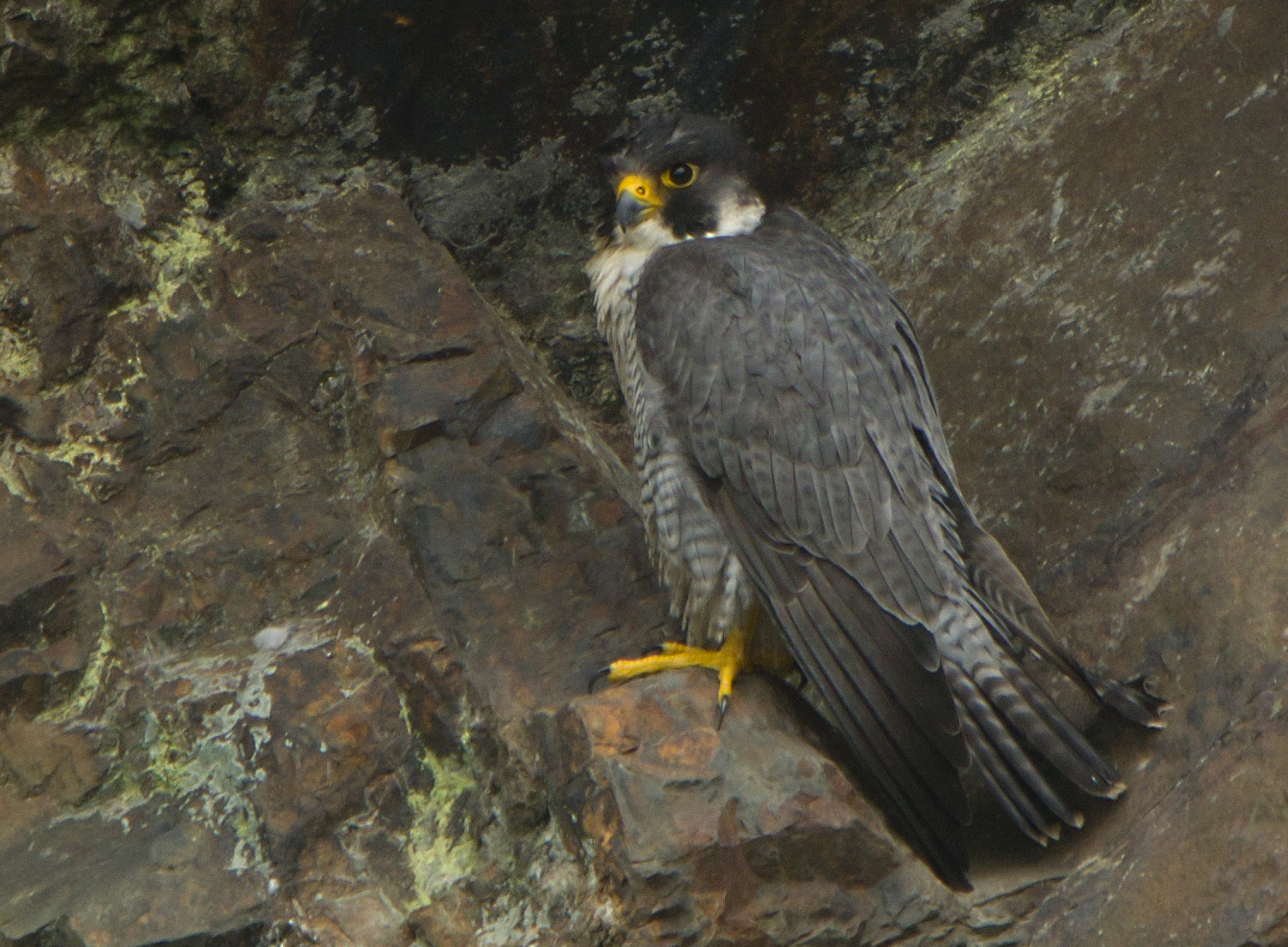
At last I managed to get a photo that I am almost happy with. In the wet and dismal conditions the tercel was sat in a reasonably dry spot. It looks like I have finally worked out how to get the best from the camera and lens. If you are not a photoggrapher then you may think that its just a case of pointing the camera at the subject and pressing the shutter. I can assure you that there is so much more to it than that! Fine judgements and adjustments are needed and getting to know how to get the best out of the camera and lens is very important.
It's a wet day again and a little damp in the hide to say te least. The inevitable drip is not the most comfortable so I don't know how the young peregrines are feeling, huddled together for warmth and with no shelter whatsoever, save for perhaps some shrubs above the nest scrape and a slight overhang above. The parents have made no attempt to shelter them for the time that I have been here, preferring to sit either next to them on the ledge, a foot or so away, or in the case of the tercel about 50 yards away on on the rock face as you can see above. I find it incredible that the adults are seemingly oblivious to the wet conditions that the youngsters are having to endure. But they dont seem to be doing too badly. They were fed several hours ago at 11 0'clock, sorry to say but it was another Great spotted Woodpecker, that makes 6 now! I had just missed the tercel feeding before I arrived. I know this because I could see that he not only had a full bulging crop but also blood from the kill on his breast. I f you didn't know or realise this, birds have a sack in the throat which is part of the digestive system. Food is packed in to this sack, called the crop, before it then passes down in to the stomach. This enables birds to gorge on food which is then stored in the crop. Perhaps this is not that important for peregrines but birds are able to take food "on board" quickly and then fly to safety to begin the digestive process. This is a good strategy that enables vulnerable birds to feed quickly to escape predation. …… by a peregrine perhaps!! Even though it's raining, as I have said, I still waited for some action. I have a remote camera set up on the favourite food exchange spot and I was hoping to record some better video of this exciting part of their behaviour. (No luck I am afraid).
I was very keen to discover how long it was going to be between a kill being brought, I remained for almost 6 hours because thats how long it took, yet another woodpecker! Oddly the female seems to be doing most of the hunting now.
She definitely caught the woodpecker because the male had spent most of the afternoon sat on the rock face. Even when she brought in the kill he didn't react, choosing to sit up there probably digesting the meal that he had consumed just before I arrived.
 Wildlife in a Suburban Garden
Leave a comment