
This little video shows from 17 secs to 1.25 the chicks being fed on a Magpie.
As I travelled out to the Peregrines this morning I was at a low ebb. It was still raining and had been, on and off for the last 24 hours with more of the same forecast.
I trudged along towards my hide and I was already wet through, how could the youngsters endure this?
How resilient are they?
How clever is the falcon?
Would she see the need to try to keep them dry?
At the hide, I barely dare even look, I lifted my binoculars and through the gloom I could see the falcon on the nest ledge and next to her, a bundle of white fluff. I prayed for movement… and there it was, the chicks, well at least one of them was OK!
As you can see from today's pictures, I need not have fretted because all three are still as strong, well stronger in fact, than ever. They had pushed under the her as much as they could and obviously by huddling together they have avoided getting chilled and also been protected from the rain by the falcon and possibly an overhang above them.
Great news.
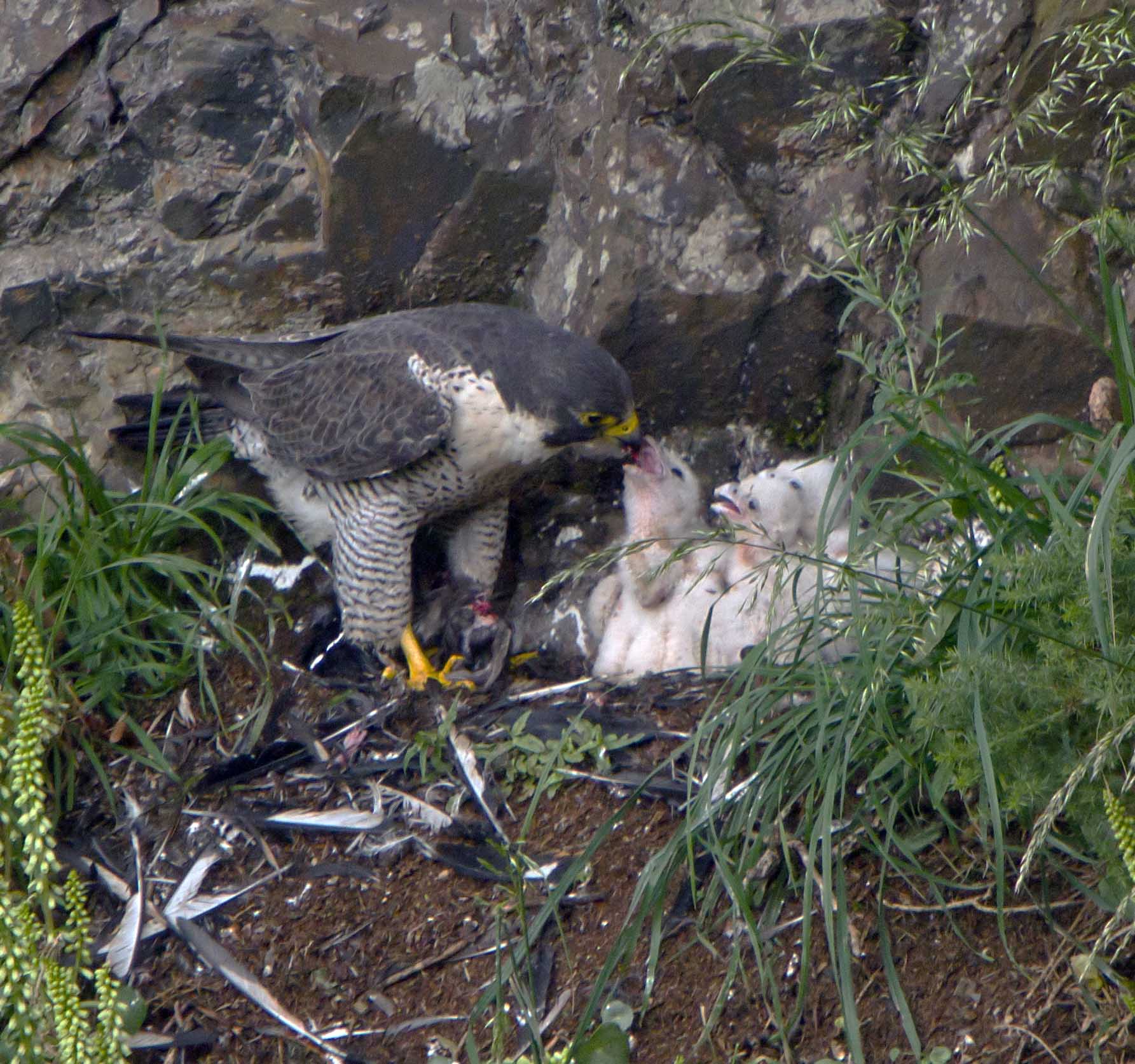
The falcon feeds the rapidly growing chicks with Magpie.
I am learning all the time about this species. It is my third year of observing this nest site and every day I discover something different. It is a fabulous way to spend a day. Sat comfortably in front of a Peregrine Falcons nest, observing their lives and recording it on film and photograph. The only way to really learn about wildlife is by observation. You can read as many text books as you like but seeing things first hand and coming to your own conclusions is the only real way.
The male is not seen all the while at the site and on the face of it, he seems to have an easy time. He never visits the nest ledge alone. I never saw him incubating this clutch of eggs, but I did see him on the first failed nest. He has taken no part in the brooding of the chicks when I have been watching. However, he has caught, to my knowledge, all of the prey for the three chicks. He rarely delivers his kills to the nest but instead he will perch on a favourite tree or opposite and scream to the falcon who will come to him and take the prey. Thi is quite often preceeded by her screaming for him to bring food. I am told that his duties will include patrolling the large territory and he will have favourite perches well away from the nest site.
When the chicks first hatched it seemed that they were fed three times a day and this continued for the first week. Now feeding has increased dramatically and they appear to have food brought to them every 2 to 3 hours or so. Prey items have included Great -spotted Woodpecker, Magpie, Bullfinch, Swallow and Blackbird with a couple of kills unidentifiable due to the plucking that takes place off the nest quite often. If the falcon is impatient she will grab the kill from the tercel and complete the plucking on the nest ledge making it easier to identify the bird.
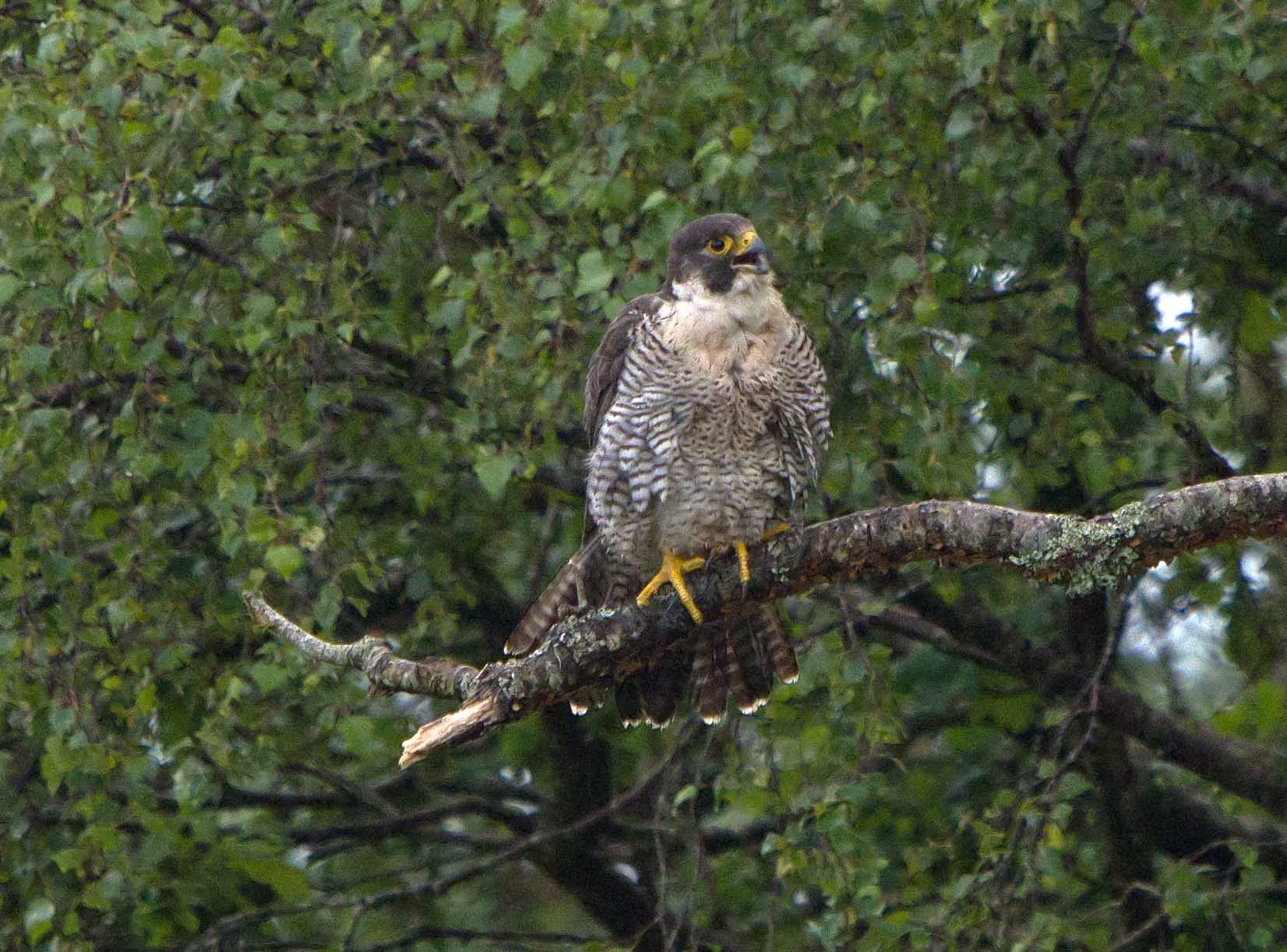
The female on the nearby tree screaming for the tercel to bring a kill
I am writing this at the hide and I can see that the female is off the nest and in a tree nearby. She had been in that spot for at least the last 30 minutes. As the chicks get older she will spend increasingly longer periods away from the nest. As I write, she has now joined them on the ledge and is feeding them on the left overs from a previous kill. Closer examination of my pictures taken earlier shows that this kill is in fact a Magpie – pica pica. I saw this as a prey item last year. It seems that the tercel is not particularly selective when it comes to choosing prey.
Related articles


 Wildlife in a Suburban Garden
Leave a comment