
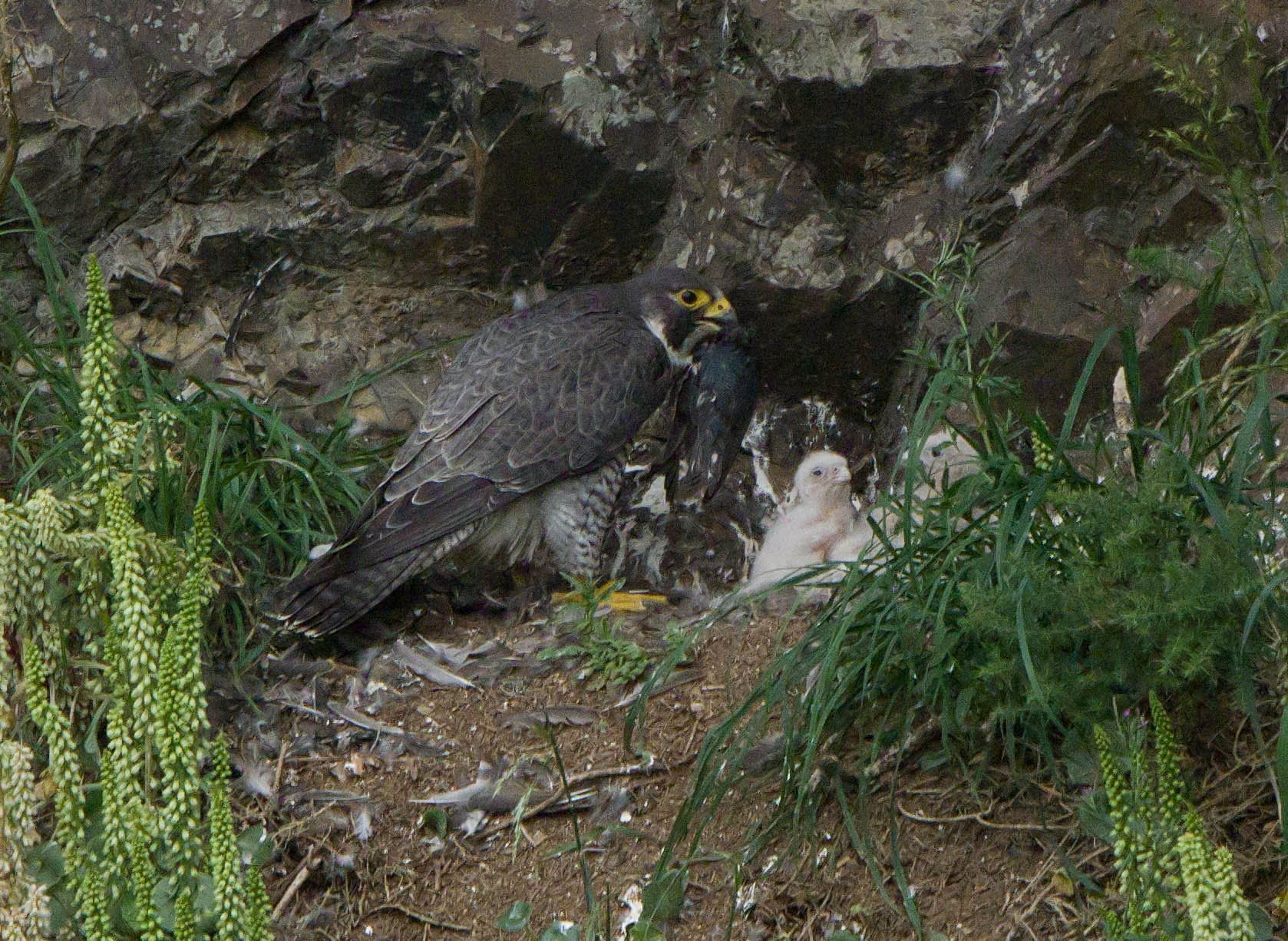
This image may go on to cause quite a stir. It is quite obviously a Barn Swallow (Hirundo rustica) I have no idea how often this species is taken as prey by a Peregrine but I now have photographic evidence that this is the case. Can you image the skill that woudl be necessary to catch a swallow in flight.
Todays session was quite significant at the Peregrine site. The chicks are now some 11 days old with the youngest one two days behind but physically not noticeably smaller. As far as behaviour was concerned, the tercel was perched on the old tree when I arrived and the Falcon was on the nest ledge with the youngsters but not brooding them. It was around midday and I was expecting some feeding activity. It was quite a wait and I was not encouraged because there was a visible large bulge in the crop of the adult bird meaning that she had fed recently. The male left the tree after a short while and wasn't seen back again for well over an hour. I first heard him call which was answered by the female, he flew in to the nest and delivered a small bird which looked to be a Bullfinch, there was an obvious white rump and I can't find another bird that would fit the description. This small finch was not going to satisfy the youngsters so it wasn't a big surprise when later on yet another prey item was delivered, this time to my utter astonishment, a swallow. In the meantime, I heard what sounded like the flapping of wings from just beneath the hide. I went out of the hide to an area that gives a good view beneath the hide and was surprised to see that this has become an obvious plucking perch. This is a favourite place that is used by a bird to despatch and then pluck the kill before it is either eaten or delivered as prey. This is going to offer some great photo opportunities in the weeks ahead. It was worth noting today that two new species were brought to the nest in the shape of the Bullfinch and Swallow. Also, it is obvious that there is no pattern to the hand over of prey. Sometimes the female will leave the nest ledge to collect a kill from the tercel or the male will bring it to the ledge. There seems no pattern as to which method of delivery is executed. It did occur to me though that the female and male not only have different sounding calls. the male being slightly higher in pitch than the female but I suspect that there is also a trigger in the male's call that indicates that he has made a kill…. and here it is!
 Wildlife in a Suburban Garden
Leave a comment