
With the chicks now 8 and 6 days old I returned as normal for a late afternoon and early evening session. I think there is a pattern of feeding. Logic tells me that the chicks are going to require food to get them through the night, obviously this gives a good chance of seeing this interesting part of the life cycle.
When I arrived I could see a peregrine in the old tree even before I had focused on the eyrie. It was the tercel. The falcon was on the ledge, shielding the chicks from the strong sun, panting with beak open and using her outstretched wings like a parasol. I got organised and sat quietly as normal. It wasn't very long before the tercel flew strongly away from his perch. I was sure that he had gone on a hunt. What magnificent and perfectly evolved animals these birds are.
Obviously, as I hadn't been watching for the whole of the afternoon I can only guess at behaviour but I would assume that both parents and chicks had spent a very quiet time in the strong sunshine and heat of the day. As soon as the sun had started to dip, the heat dropped a degree or two and this was the trigger for the tercel to leave to carry out his particular parental duty, that is, to catch prey for the chicks. Yesterday, even though I couldn't see him, I knew he was somewhere in the old tree because downy feathers were rising to be blown gently in the afternoon breeze as he plucked and ate a kill. I have seen this before so I knew that nothing else could be the cause. I was correct because when the tercel eventually delivered the prey it was partially, if not almost entirely eaten. So much so that, apart from a few remaining wing feathers there was nothing to indicate the species but it looked very much like a gull of some sort.
After nearly 3 hours of waiting this afternoon and as it got cooler and cooler, still the tercel hadn't returned. It seemed as though my original guess at behaviour was well off the mark. Wildlife watching is very much like that. One day, yesterday for example, within minutes you will witness some excitement and have great photo opportunities, then the next day there is nothing to see at all. Both the falcon and I listened intently for the characteristic screaming of the tercel which would indicate his return but all I heard was a nearby Great spotted Woodpecker, proving that in spite of the Peregrines predating two of these recently there are still more, I wouldn't want to be a woodpecker living near here!
Then at around 8, the falcon left the nest and seemed to be calling for the tercel to return. The young birds in the eyrie stretched for food but still there was no sign of his return. We had all started to run out of patience…..even the cameras battery started to run out! But I was really interested to see if they would be fed before dusk turned to real night.
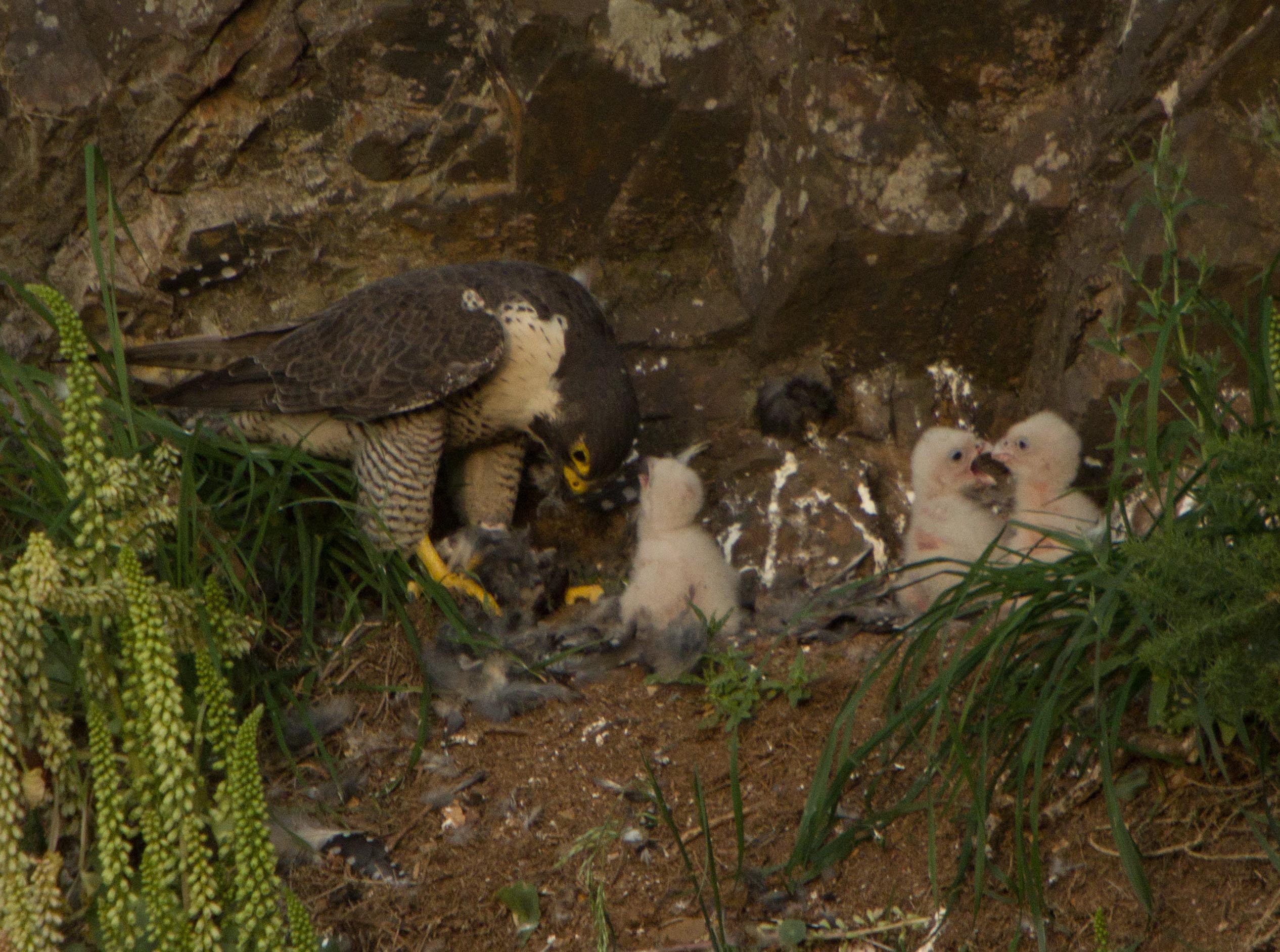
Mu wait was rewarded when suddenly at 8 20 the tercel returned. There was a great deal of excited screaming as the hand over of prey took place, not on the ledge this time but on the favourite tree. I quickly trained my camera back on the eyrie to see the female frantically plucking a bird. One of the chicks was even pulling at the tail of the kill which was yet another Great spotted Woodpecker. This species seems to be easy to catch. I am told that they are a particularly stupid bird, more common than they have ever been, so obviously a good food source.
I returned on Monday to find the falcon on the eyrie and the youngsters in the nest scrape as normal. The falcon is now not brooding but just stays with the chicks on the nest ledge. I never see the tercel on the ledge, he is sometimes perched nearby but usually there is no sign of him. After a short time waiting, suddenly again I heard the distinctive sound of the males scream . It was quite obvious that he was perched out of sight and beneath me. The female left her ledge flew over to him and took delivery of a female blackbird and carried it back to he chicks. She plucked it as normal and began to feed the chicks as before.
 Wildlife in a Suburban Garden
Leave a comment