
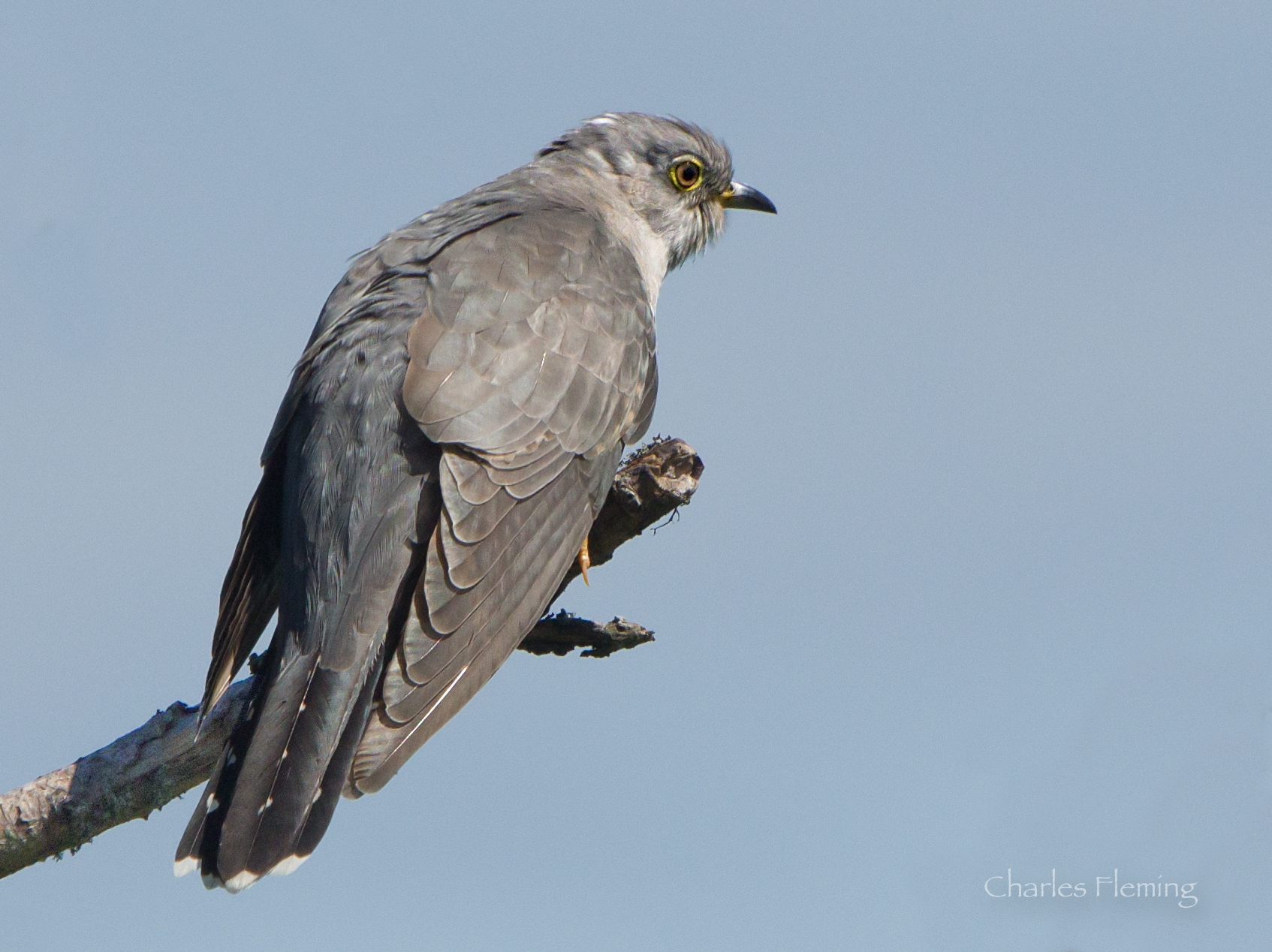
I went out to the moor a bit earlier this morning, I wanted to see if my theory that the Cuckoos don’t start to feed on the short grazed grass until late morning was accurate.
It seemed to me, as I approached the area, that there was a bird in the hawthorns but I didnt see it depart. I must have disturbed it as I put tripods up etc. and there was no sign of it once I was ready. It was a while before I saw a Cuckoo again, perhaps supporting my theory that they have a different feeding strategy in the early mornings.
In the meantime I was entertained by some cracking little species. A beautiful male Redstart was followed by a female Pied Flycatcher and then the male, ust wonderful. Only last night I had talked to my friend Jan about Yellowhammer and here was a beautiful male. So on this tiny area, the size of a small English lawn I have had, in the last week, quite an exotic list of birds. Jay, Kestrel, Pied Flycatcher, Redstart, Yellowhammer, Bullfinch, Mistle Thrush and of course Cuckoos of both sexes.
As my session progressed I was joined by Professor Charles Tyler, a scientist who is in the 10th year of a study of the ground nesting birds and Cuckoos in this area. What an absolute privilege and a great opportunity to learn even more about Cuckoos. As he set up I quietly fired questions at him. I was surprised to learn that it is the female that holds territory and this area is hers and apparently there are three males. I asked him if it is possible that there are two females which is unlikely but possible. The males patrol around trying to get the chance to mate with her.
Suddenly the female landed on the tree, I took lots of good pictures……again, but Charles wasn’t in a great position and couldnt get on to it properly from his spot. I decided to give up my hide to him as apparently it’s not that easy to get a good shot of a female and I have loads already. There is always another day as well and there is going to be lots more good opportunities. The search is on for Meadow Pipit nests containing a Cuckoo egg or young and as soon as that happens I have been promised the opportunity to photograph at it.
Charles told me that every Cuckoo lays an egg that not only mimics it’s host but is also patterned in a way that is unique to each bird. I asked if Tree Pipits are ever victimised and Charles told me that Cuckoo eggs have been in Tree Pipit nests. However, this is called egg dumping, when a bird is unable to find the nest of its preferred host. Incidentally, Cuckoos are genetically programmed to use a particular species of bird. The Cuckoos on Dartmoor use Meadow Pipits.
Related articles


 Wildlife in a Suburban Garden
Leave a comment