
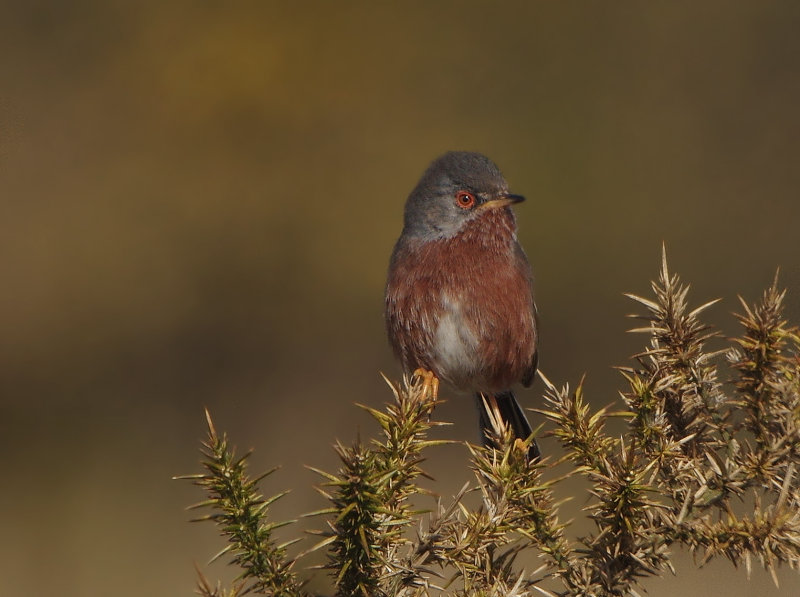
Its been a terrible day again today, yesterday was almost spring but today it was winter again. It was not a day to do anything outdoors and after the success of yesterday when I had watched a male Dartford Warbler singing in the sunshine I was quite deflated to be honest. I have been looking again at some of yesterday's pictures and selected this one to post. Sometimes when you take bird photos the resultant image can display colours which are different than the subject in reality. If you have not seen Dartford Warblers before than I can confirm that this is a quite an accurate representation.
Dartford Warblers are members of the Sylvia family of warblers, they are related to Blackcaps and Whitethroats but they seem much more closely related to the Mediterranean species such as Sardinian Warbler, Ruppels Warbler and the visually very similar Subalpine Warbler. I have done just a little bit of research and seen that there are 27 or so members of the family and many are exotic and very desirable as a photographic subject. It is a real priviledge to have Dartford Warblers in the UK, my county. Even though Devon is one of the strongholds of the species and I doubt if there that many here, it is still a bird that you really have to look hard for and then get very lucky to get close enough to photograph them. I have been doing quite a lot of searching and studying of this species during the last few months, really trying to get a hold on them by learning as much about them as I can by personal observation. Its not been easy, it isn't easy, but it's the way I like to do things. Dartford Warblers are described as very secretive and I usually see them when they fly low from one heather or gorse to another.
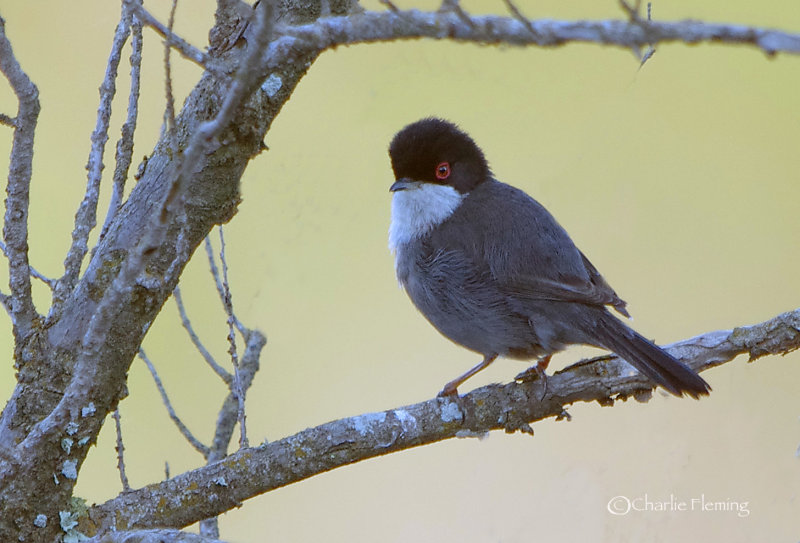
The Sardinian Warbler, another very attractive Sylvia warbler is a bird that I have seen regularly when I have been in Spain, Portugal and the Balearic Islands. Their behaviour is simualar and you struggle to get a view even though you can hear them in the bushes and low shrubs. Suddenly they will show themselves, momentarily, just like Dartfords showing themselves to sing from an exposed perch. In Gibralter many years ago I came upon one that had been hit by a car on the road leading up to the top of the rock. I held it in my hand as it came back to life. I was stunned by the beautiful red orbital eye ring, a feature that it shares with the Dartford Warbler. Heres a photo of one that I photoographed in Menorca in 2012. You can clearly see they red orbital eye ring in bothe pictures.
 Wildlife in a Suburban Garden
Leave a comment