
Nest building continued today, Thursday 8th March, one week on from first discovering this nest site. I arrived at around 10 this morning and both birds took an equal part, building until just after 1.00. There was nothing different about today, mostly moss and the occasional piece of grass were brought. Moss is gathered from boulders high and dry or sphagnum moss from the dry bank. The male seems to have a preference for sphagnum, the female gathering mostly aquatic moss. At one point the male responded to an alarm call from the adjacent woods, he left the nest and perched on the rocks beneath and then sounded a musical call of warning to his mate and they both departed. I suspected that there was a Sparrowhawk nearby, I looked around but couldn't see it for myself. I undertook a count of visits to the nest for an hour between 1120-1220 both birds between them visited, with nesting material 17 times. A pattern of leaving the nest seems to be developing, as soon as one of the pair arrives, the other bird immediately flops in to the water beneath the nest and then swims down stream to a nearby rock before flying off to gather more material. On some occasions the male would instead, fly upstream returning quite a while later.
Photography at this site is extremely demanding, the light always just a tad on the dim side. If you are a photographer you will know of ISO but what does it mean? ISO stands for International Standards Organization, it is the standardized industry scale for measuring sensitivity to light. it pertains to the sensitivity of the digital image sensor in your digital camera. ISO is measured in numbers, with the lowest number being the least sensitive to light, (e.g. ISO 50 or 100), and the highest number being the most sensitive to light for example 6400. If the ambient available light is poor than by adjusting the camera's ISO to a higher number, photographs can be obtained in dull situations where you otherwise would not have been able to. But there is a comromise, a severe degrading of the image quality. At high ISO settings images are grainy and detail is obscured by this "grain" which is known by photographers as noise. Photography is all about compromise and, in a nutshell, to adjust the camera to get a high enough shutter speed to freeze action has meant using a high ISO and this rarely works satisfactorily. The compromise comes in the shape of a slower shutter speed meaning a less grainy image but difficulty in getting a none blured image. Trust me it's very frustrating. Every photograph here has been taken putting all thos compromises in to action and hoping for the luck of a shaft of light or a perfectly still bird at the same instant that the shutter is pressed. Here's a few examples.
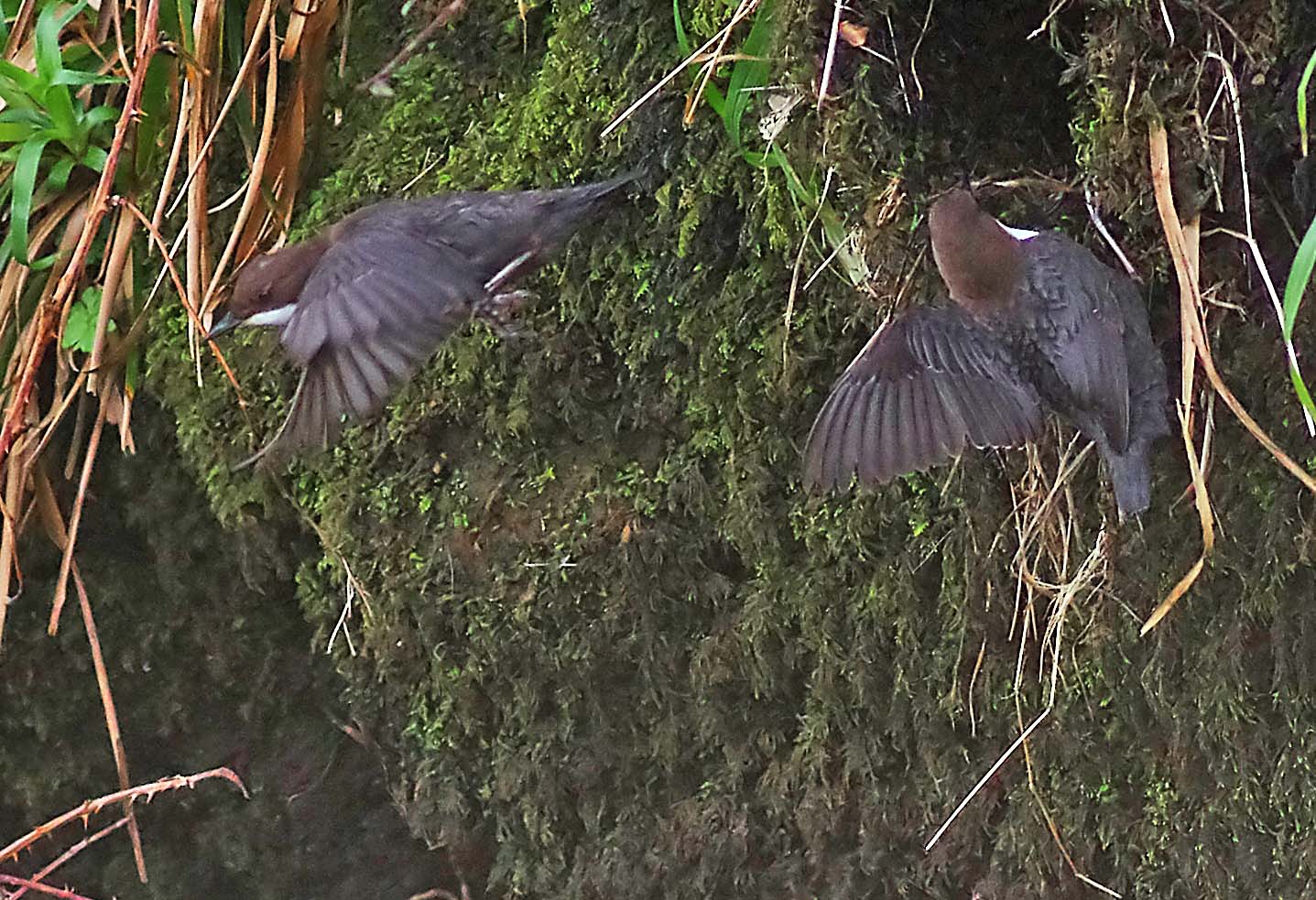
This one was taken as the birds swopped over at the nest, the female exiting to the left as the male arrives to go in. The action is almost frozen but you can clearly see the "grain" on the birds feathers but it is not so noticeable on the background. To get rid of the grain I would have needed to set the camera at a lower ISO and the shutter speed would not have been fast enough to freeze the action. The compromise was to keep the image a little duller/darker than is perfect……. like I said very difficult to acheive good pictures in these conditions.

In this one the light had brightened a little and I was able to acheive a shutter speed of 1/1200 second, just not quite fast enough to entirely freeze the image……. but almost. But it has almost captured the moment as the male dives out of thenest and towards the water just beneath.

In this one the bird was in almost full sunlight but the camera has reacted to the glare of the water behind, never the less I was able to quickly adjust the camera to take it's settings from the bird and mange to get a shot of the bird gathering moss for nesting material. Again recording an important aspect of the Dipper's breeding behaviour. The lens used to take the pictures is a Sigma 500 4.5. and it cost a massive £3999. To by a 500 with an available aaperture of 2.8 meaning that I could obtain faster shutter speeds with the reach of a 500 lens would mean spending almost £10000, not many amateur photographers canafford to spend that kind of money , and that includes me!
 Wildlife in a Suburban Garden
Leave a comment