
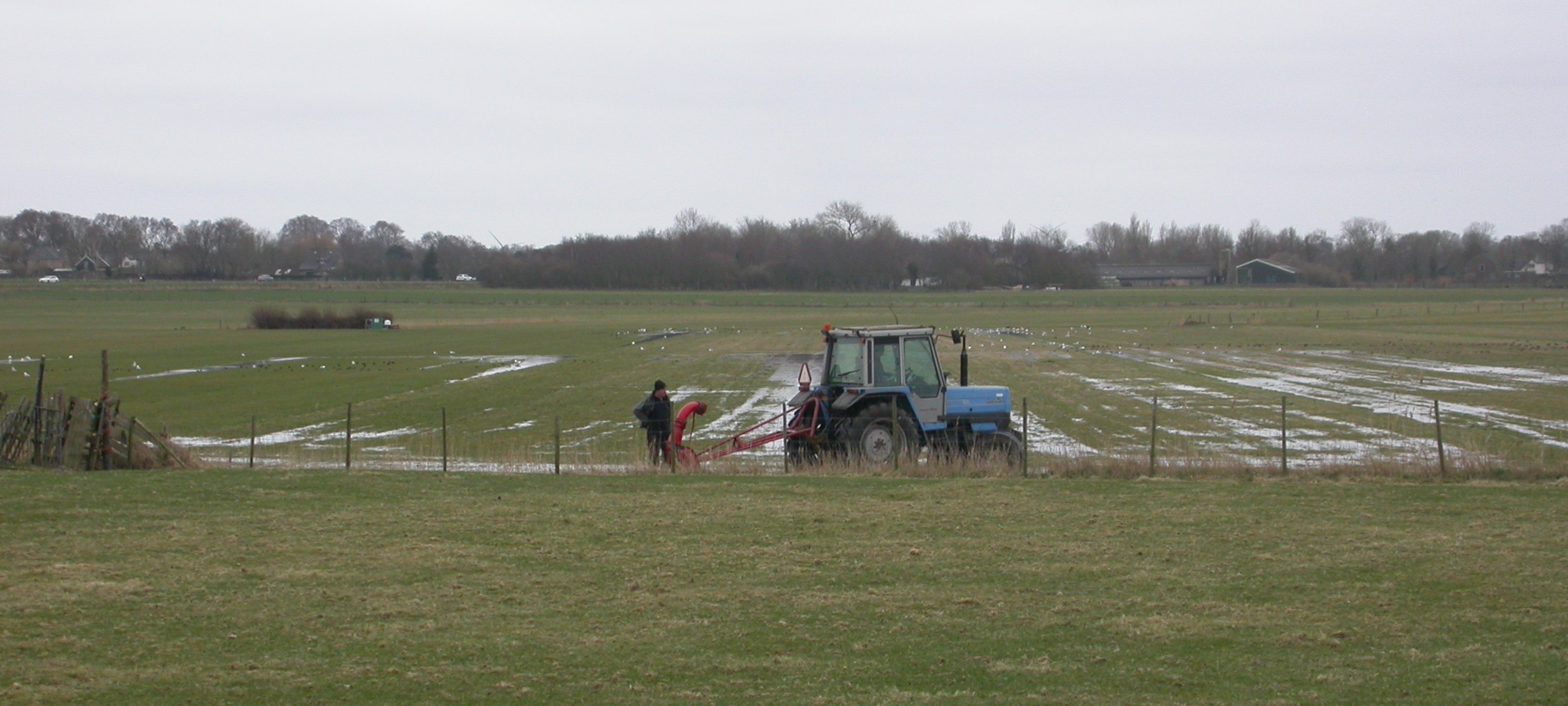
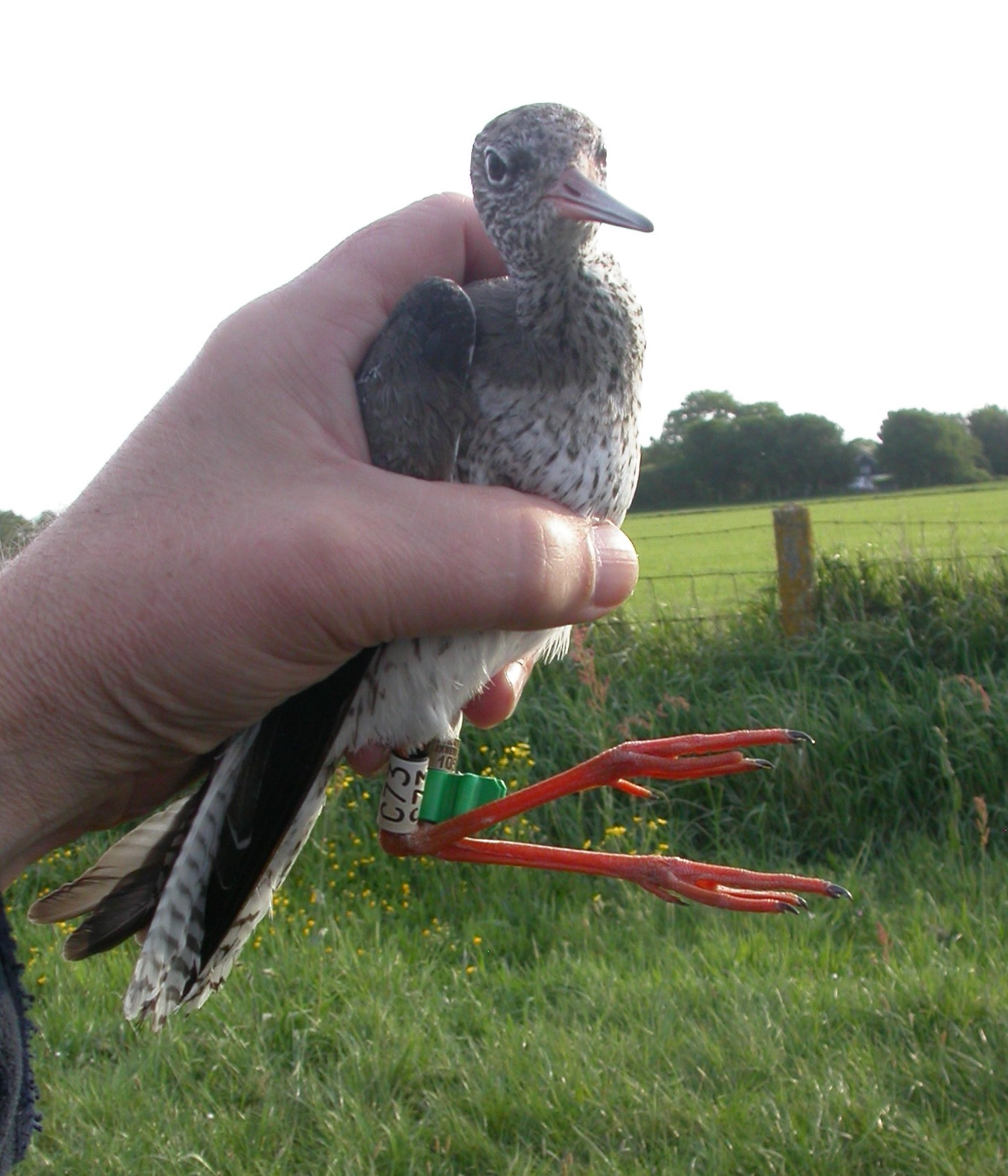
On Friday I photographed a colour-ringed Redshank that was wearing a green transponder on her left leg. "Her", how can I be so specific? Well, it hasn't taken long to discover a lot of information about this interesting little wader. Pictured above is the farm field where she was hatched, where she spends the summer, and where she herself bred this year and reared at least one chick. She is 7 years old and earlier this year she was fitted with the green transponder on her left leg. This is part of study by Dutchman Wim Tijsen who lives nearby in De Dolven, Westerland in the Netherlands. Here is a copy of the two emails I received from Wim yesterday:
"Thank you very much for this important sighting! The first evidence that this bird is really wintering in your area, while all my other Redshanks are wintering in Portugal/Spain and even in Guinnee Bissau in Afrika! I have add your sighting to the database via the website below. So if you see this bird more, you can make your own account on this website, which is also in English.
I use this bird always in my presentations, because its feeding in the same sort of area, where it feeds in late summer at Waddensea-coast Balgzand, close to my home. That is very funny, because its just in a opposite position, along a canal what is loosing the water along a sluice at the Waddensea. And in your area there is also a kind of sluice, where it feeds along an outlet of water…
I live 1 km from the Waddenseacoast and the bird is breeding also 1 km from my home at Normerpolder.
I have included the life history in an excel-sheet.
Also included a article which was in the Wader Study Group Bulletin, which give you more information about my project. The green flag is a transponder, which will give us more idea hopefully next spring about the difference in breeding between male and female. We put a metal ring around the nest and every time the bird goes on and off the nest, the datalogger detects the transponder.
So hopefully it will come back next spring, so keep an eye on her! And send her safe back…"
……….and then a reply to my email to him where I said how thrilling it was to find out about the bird.
"Hi Charles, yes indeed it's great that this bird is behaving different, that's fascinating. But maybe by the warmer winters they tend to winter closer to there breeding area as they used to do. Here is a picture when I caught her back last spring to add the transponder, I caught her with my landing net. They raised at least one or more juveniles this spring despite the very dry summer. But the farmer I am working with is into nature farming and mow's his land very late, after 8 june or later for the birds in schedules. If you look at the lide-historie you can see that the farmer (Jan Mulder) also caught her back by hand when she was a juvenile.
My main study area is around a skating rink in a open polder of 40 hectares, the skating rink is specially a wet-grass-land area, where the farmer get paid for. It is wet for 60% untill 15-5.
This year my farme rpumped his land wet during the dryness, specially forthe meadow birds.
In this area we have 15 paires of lapwing, 10 pairs of godwitts, 25 pairs of redshank and 20 oystercatchers."
On reading her life history I discovered that she has been to the Exe before and was seen at Turf in 0n 10 November 2005 but it's not sure if she stayed for the winter but wasn't seen back in Devon until this November. Did she go further south in the winters between? Wim's other Redshanks all spend the winters in Spain or Portugal and one as far south as Africa.
How fascinating is this? To see photographs of her back in the Netherlands is really interesting. It also speaks volumes about the important role that ordinary people like may can make just by being observant and inquisitive. I will post more about her here especially if I see her again in the weeks to come.
 Wildlife in a Suburban Garden
Leave a comment