
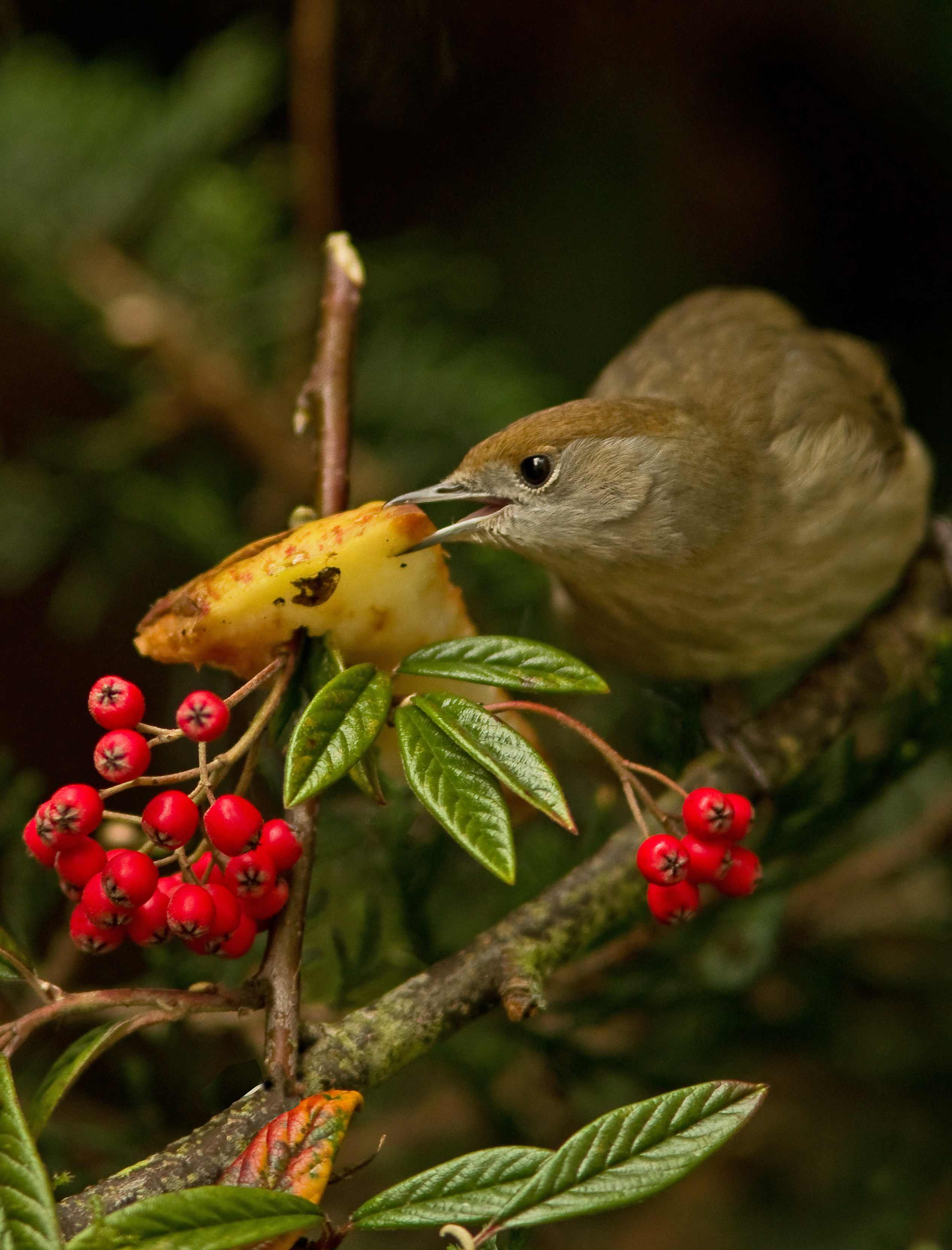
I have been in the process of writing an article for the Devon Life Magazine this last few days. I recently had a piece published about Kingfishers which looked great in print and I was very pleased with it. The latest is this article to be published in January, here is a preview, and to go with it a nice photo of a female taken in the bitterly cold garden today.
"Blackcaps are a familiar sight in many Devon gardens during the winter. They are now so common that they are almost taken for granted. But to do this would be wrong because their presence in our gardens hides a fascinating story. Blackcaps are small warblers that breed in the woodlands and hedgerows of not only Devon, where they are particularly common, but throughout the United Kingdom and the rest of Europe. . Hundreds of thousands arrive here in the Spring from Southern Spain and North Africa. The males immediately establish territories and begin to sing their rich and tuneful song. With the arrival of Autumn, and completion of the breeding season, they migrate south again and are then replaced by Blackcaps from Northern Europe, and this is where our story begins.
I first started to notice the Blackcaps in my Alphington, Exeter garden several years ago. I was thrilled to see one feeding on the leftover apples still clinging to the tree even though it was late October. I watched, over several days and during that time I saw both males and females feeding from the same apple, but never together. This presented some lovely photographic opportunities which I gratefully accepted! Throughout that winter, and every one since, Blackcaps have spent the winter in my garden and the surrounding ones.
Blackcaps are about the size of Great Tits, which is slightly larger than other warblers. They are unique amongst European warblers in that the males and females can be immediately distinguished. Both sexes are a nice shade of light grey, but the females, instead of the black cap, have a lovely chestnut one instead. By the time these Blackcaps arrive here in the Autumn, even birds that were hatched this spring and summer will have acquired their adult plumage. My garden is typical of thousands of suburban ones throughout Devon and, is a haven for wildlife and particularly birds. However, what is perhaps different is that I have some strategically placed hides around that allows me to get intimately close to the birds and other wildlife that passes through.
Blackcaps totally fascinated me, and having an enquiring mind, I decided to try and find out what was going on. My research led me to discover their secret. When Blackcaps began to be seen more and more over the winter, most people, even professional ornithologists assumed that these wintering birds had bred here in the UK and then because conditions seemed more suitable, had decided to stay. Our winters appear to be getting milder and the practice of garden bird feeding is getting ever more popular. A dramatic chain of events unfolded. A male Blackcap was discovered dead in a garden in Southern Ireland during February more than a decade ago. Fortunately for science, not only was this bird wearing a metal ring, it had died in the garden of a keen ornithologist who immediately recognised the opportunity to discover this birds provenance. After investigation, it was discovered that this bird was ringed as a chick in a nest in Germany, which was quite a startling revelation. The news spread throughout the scientific birding world. Then, a German ornithologist decided to undertake a ringing study both in Germany and here in Devon. Birds were captured in Germany during the summer months and rings were fitted. These numbered rings allow for birds to have their own unique identity recorded. Some of these birds were subsequently re-captured in the United Kingdom and Devon in particular during the winter time. With their unique ID rings it was possible to confirm that our winter population was of German origin. However, what makes the Blackcap even more interesting is that not all German Blackcaps come to Devon for the winter. Some continue, as previously, further south. But what is doubly interesting, Anglo- German birds have gained a big advantage over those that migrate greater distances to Spain and North Africa. It seems that our birds, because they have fewer miles to fly back to Germany before breeding, arrive back in their summer territories earlier than their southern migrating counterparts. With a shorter migrating journey they arrive back fitter and are able to claim the best breeding territories, thus, outdoing those that migrate further. Because of this advantage, it is thought that the Anglo-German birds will eventually rep[lace the southern birds. Genetically, two separate races are developing and this is thought to be evolution in progress, and literally here, right on our doorsteps!
So why should we be interested? Well studies have shown that Blackcaps here in the UK for winter, rely almost exclusively on garden bird feeding. So we can be proud to know that we have had a massive impact on this lovely little bird that is such a delight to see now in the back gardens of Devon.
If you haven't had Blackcaps in your garden yet, or perhaps you haven't noticed them, you can encourage them, as I do. From the middle of October and throughout the winter, I place apple slices on the edges of my garden shrubs and bushes. I choose mature plants and then push the fruit on to exposed twigs in places where the birds can retreat quickly back in to cover. I also position the fruit where I have a clear view from indoors without disturbing the birds. The fruit will quickly go brown but this is the way the birds like it, when it softens, the sugar content increases. Also, as the birds eat the soft brown fruit it is easy to see if it has been eaten while you were not looking! Blackcaps also have a fondness for suet and fat balls and are equally attracted to theses free offerings as well. They are a really wonderful addition to our garden bird populations and certainly make my garden bird watching a more interesting and exciting pastime and one that I hope you will be able to share in. "
 Wildlife in a Suburban Garden
Leave a comment