
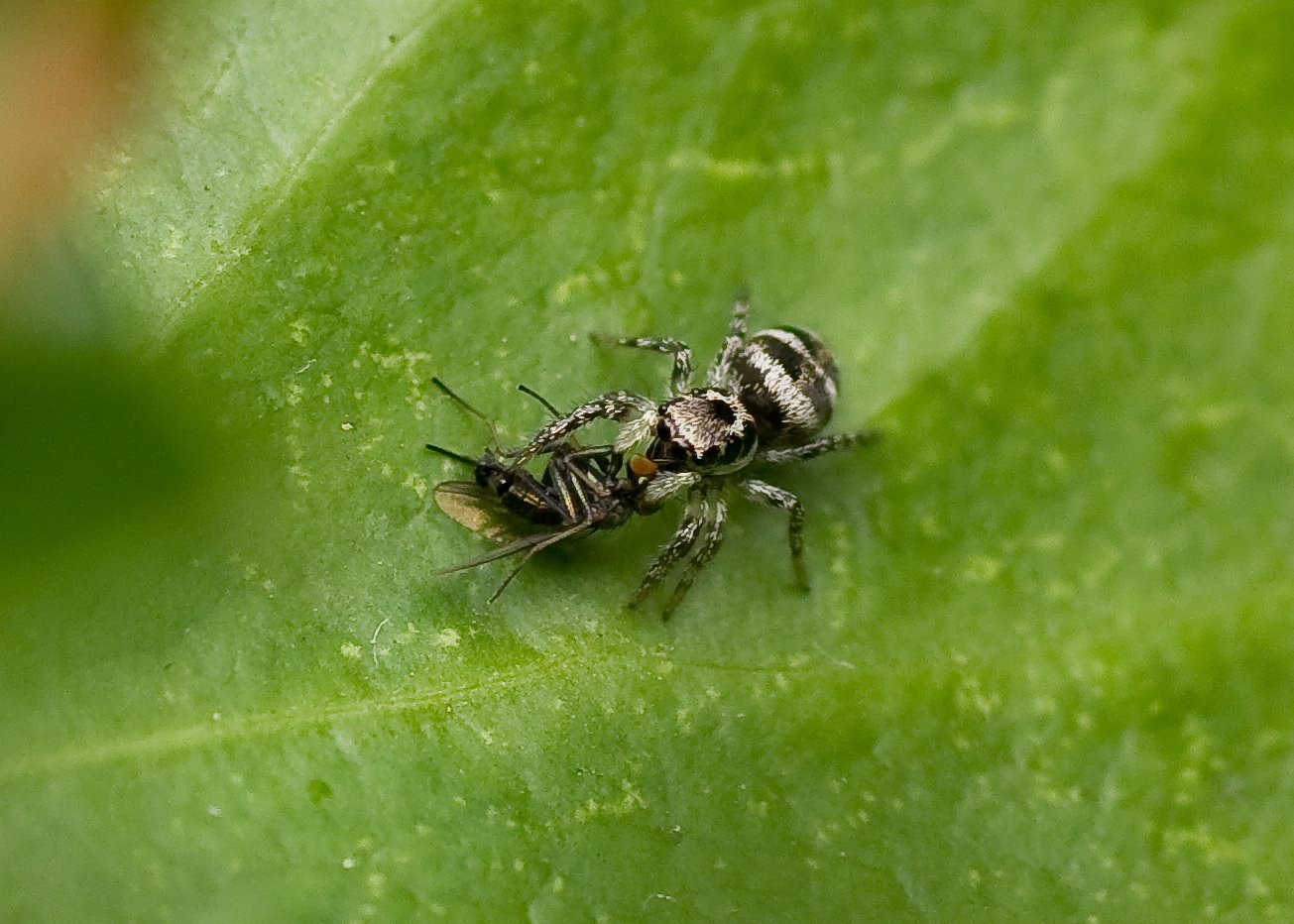

This is a Zebra Jumping spider photographed at around 10 times life size, they are actually 3-mm long. I noticed it this morning in bright sunlight close to my house. I love these little spiders. They are always very endearing but also voracious hunters. They do not use a web to catch their prey but instead hunt by stealth using their brilliant eyesight , well they do have 8 eyes! They are capable of creating thread from a spinneret which they use to anchor themselves if a leap is unsuccessful, like a rope they can then crawl back up. Notice in the top picture that it has a fly in it's jaws which it is in the process of consuming. If you double click on the image it will open up larger in a new window and you can see a little better. I find it fascinating that this species is also found in the USA as well as Europe proving that they are a very ancient species that lived when their was a common continental land mass millions and millions of years ago. A bit more searching as the day went on found me 2 more so I suspect that they are quite common in the garden at present.
A Speckled Wood Butterfly was in the garden today and also a very interesting but sadly, damaged Queen Bee Bombous terestris. She was crawling very carefully around the grass. The Bee unfortunately was infested with mite, again a bit of research has shown that this is a very common occurrence and not thought to be too debilitating. I took some photographs through a microscope connected to my mac and I found them to be repulsive and in comparison to the bee, large parasites to be carrying around. I am surmising that their presence on the bee was part of the reason that she was suffering so much. The mite are Parasitellus fucorum.
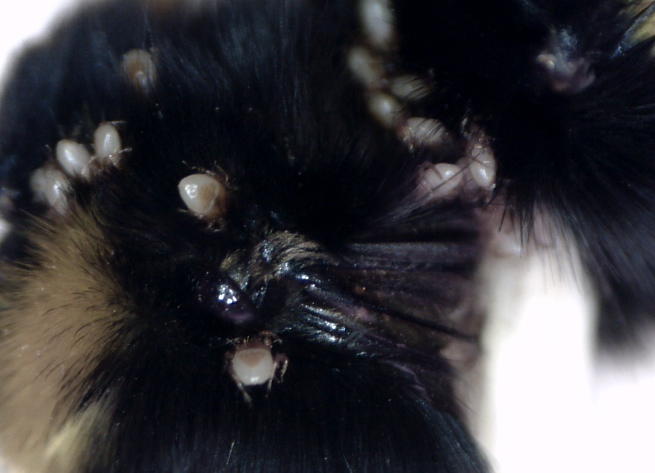
I find this interesting not only because of the mite but also it illustrates just how hairy Bumble Bees are.
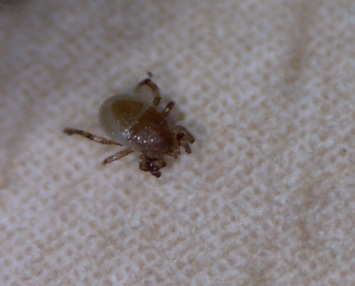
These mite are in fact about pinhead size . You can see that they are arachnids with 8 legs like spiders and ticks. Having been bitten by ticks a few times this last few weeks I am not all that fond of these group of animals. Apparently this species of mite does no harm to the bee except perhaps burden it as a passenger. It is thought that they may actually benefit the bee by keeping the fur clean, somehow I doubt it!
 Wildlife in a Suburban Garden
Leave a comment