
It was 0744 when I was sorted and tucked in to the hide, the Kingfisher was with me at 0745………. amazing. Not a lot of waiting around today then. It was interesting behaviour. I saw him coming down the stream towards me and I thought he was going to flash past. I was wrong, instead, he stopped in mid-flight, hovered momentarily and then splashed into the brook emerging to perch, wet onto the branch 5 feet in front of me. He preened, scratched and dived in and out of the water as usual. The difference in behaviour was the way he had dived in whilst in mid flight. It was also notable that he seemed to make a "bee-line" for the branches in front of me. After he had completed his ablutions, off he went back in the direction he had appeared from. What can be deduced from this behaviour? It has become quite obvious why I hadn't seen him in the 2 previous early mornings. My early morning hasn't been early enough! With the days lengthening as spring approaches, I have arrived too late at the hide. Bathing always takes place after fishing so it is obvious that by 0745, fishing and feeding is completed. Oh no…………I need to get up earlier!

In common with the previous mornings, by 9 I hadn't seen him again, who knows where he goes. He is still here, roughly in the same area however without any movement to a breeding territory. I know that it is wrong to anthropomorphize but I do imagine him thinking things through and having a strategy, I always wonder how much of his behaviour is purely instinctive, probably all of it, but it's hard to believe that there is not a degree of cognisance.
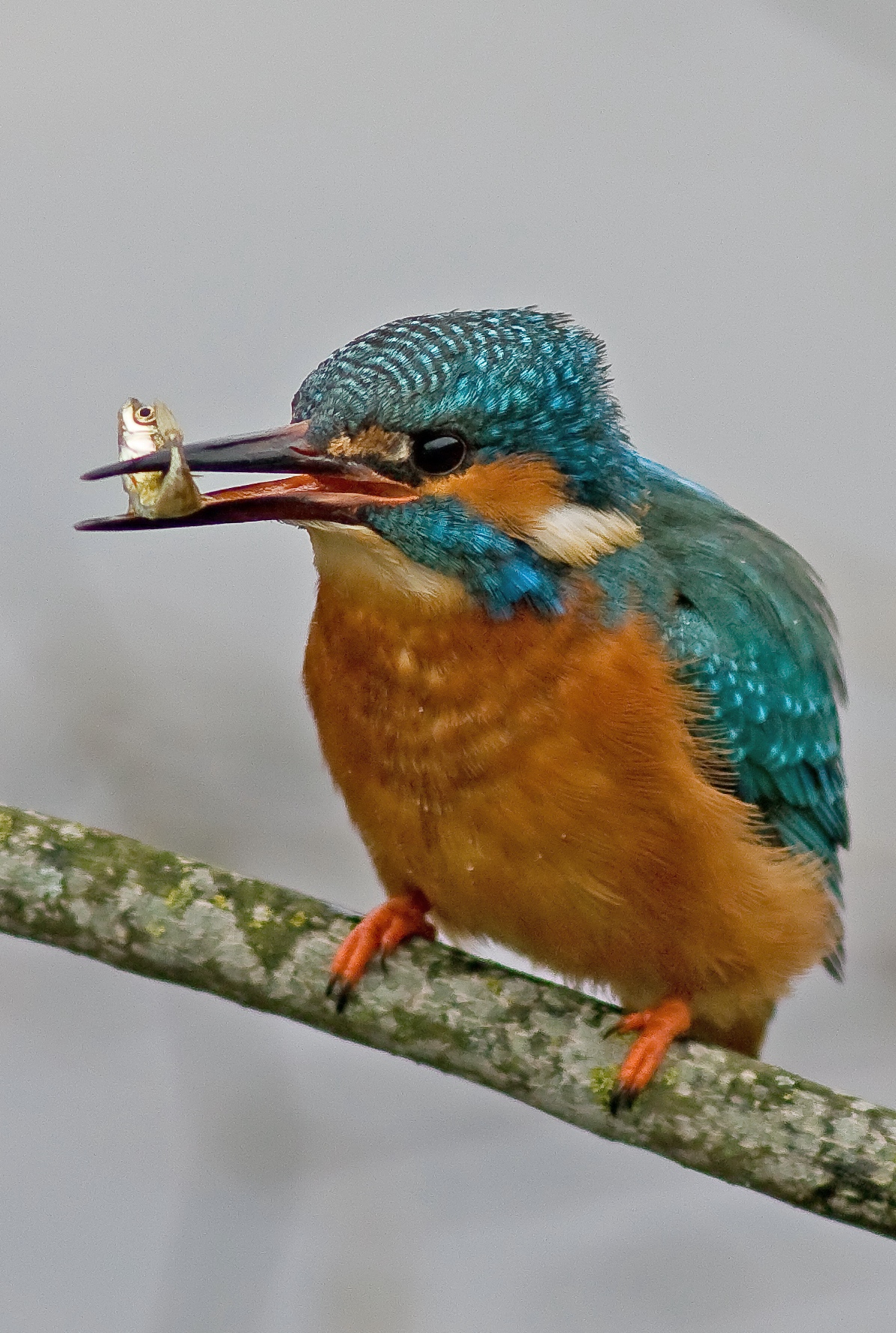
I returned to the water at just after 3pm as I had a little bit of spare time. I sat and watched the late afternoon fishing session. The light is poor from this hide at this time of day but it is always interesting to watch him and I always hope to see some new behaviour. At this session he caught 4 fish and also had his usual bath which I filmed on HD digital film. With one fish, he beat it so hard from side to side that not only could I hear it slapping on the branch, the branch was also bouncing up and down. I knew when he had eventually had enough fish because I could see him flying very quickly away upstream and out of sight. The fish that he is eating is a Nine Spined Stickleback, larger than it's relative the Tree Spined. Note also the gold iris of the eye, silver in the smaller species. I mention this because this species is pretty much what he is exclusively feeding on at the moment. I did see him with a minnow once last week however. In the Autumn I saw him feeding mainly on Three Spined and Minnows as well as Loach, a Millers Thumb and a Common Newt. If you look closely at the picture you can see how I had troubles with "Depth of Field" in the dullness this late afternoon. When The bird is as close to me as he was today and I had the camera set at the highest shutter speed possible, but there has to be a compromise. I opened the shutter up to it's maximum of 2.8 which means that anything at the point of focus is sharp but areas further away, or nearer for that matter are going to be out of focus. The beak is sharp but the feet are not. If I compensated for this, then the shutter speed would consequently be too slow to "freeze" any action and the whole image would be fuzzy. if I adjusted the ISO then the image would be grainy……… photography is all about compromise. Bright conditions pretty much make theses compromises less critical.
 Wildlife in a Suburban Garden
Leave a comment