
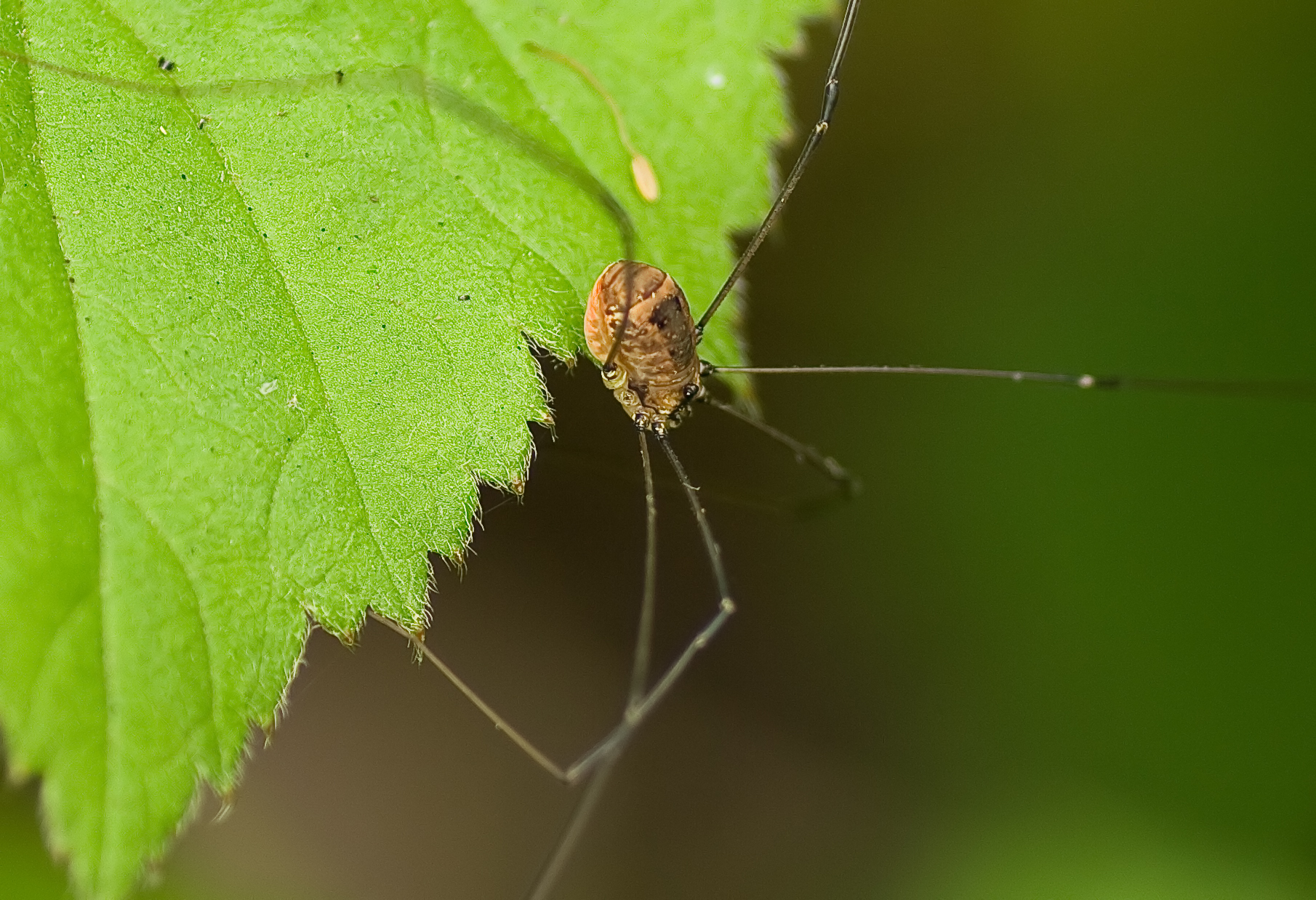
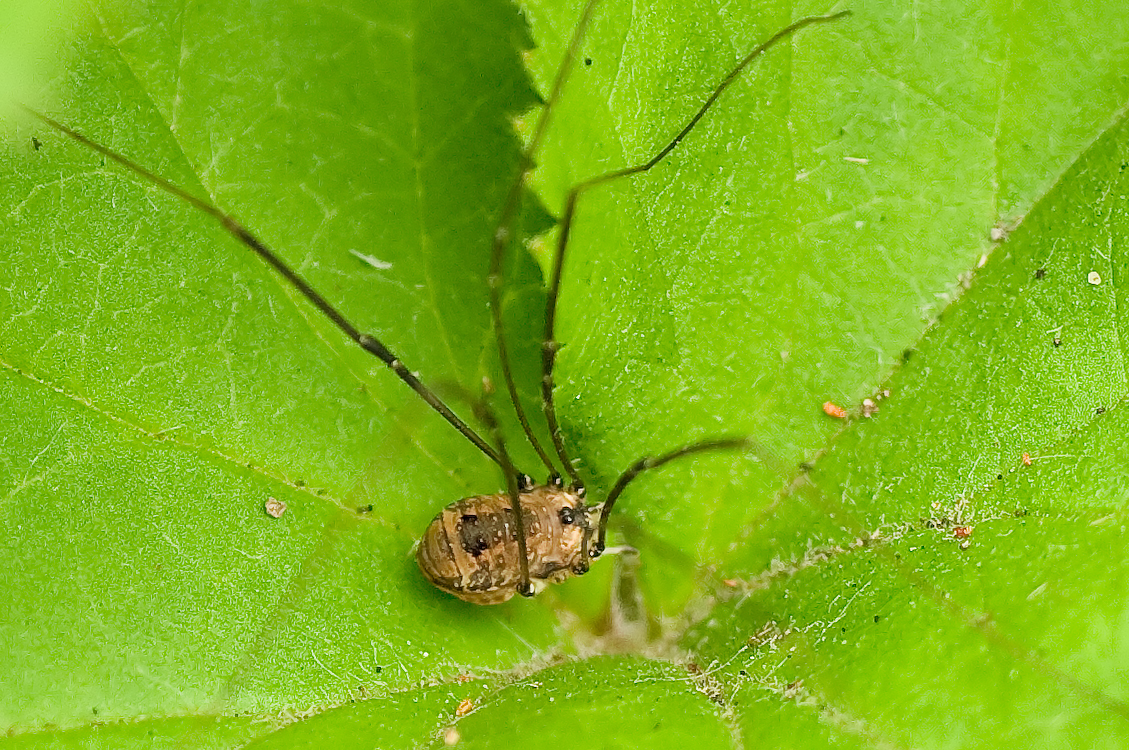
I wouldn't say that things are getting back to normal but I am starting to feel a bit less sore and a bit mote mobile. I put a chair next to the flower bed today and with the camera on a tripod and a remote shutter release, I just sat and waited for something to show it's self.
With a bit of patience and perhaps with the help of my new glasses, it wasn't long before I spotted, what I thought was a spider. Turns out it wasn't a spider at all but a Harvestman. Arachnids are not insects but a separate group that contains Spiders, Scorpions, Mites, Ticks and Harvestmen. There are 26 species of harvestmen in the UK and they differ from spiders by being non venomous. They also lack the ability to spin a web. They catch their insect prey by grabbing with their legs which are equipped with hooks. They use their extraordinarily long legs as feelers much the same as antennae. They have the ability to shed a leg to escape predators. The one pictured has a leg missing. This is the first Harvestman I have seen in the garden, and good to see, photograph and record. But, do they breed in the garden, how many eggs do they lay, how long to hatch?
Harvestmen are ARACHNIDS of the order Opiliones. Harvestmen is the preferred term but they are commonly called daddy-long-legs – even though many have short legs. Moreover, "daddy-long-legs" is also used for cellar spiders (Pholcidae) as well as crane flies (Tipulidae).
Description
As with other arachnids, harvestmen have 4 pairs of legs and 2 pairs of mouth parts – chelicerae and pedipalps. Harvestmen are unique among the arachnids in that they possess a pair of scent glands, which are located lateral to the second pair of legs. The glands secrete a liquid or spray used primarily for defence. If a predator grabs a harvestman's leg, a specific joint will usually break (called limb autotomy), leaving a twitching leg but allowing the arachnid to escape. The leg is not regenerated. Harvestmen are distinguished from spiders in that harvestmen have one body part (spiders, 2), 2 eyes (spiders, usual 6 or 8), no silk glands, pinching chelicerae (spiders, fangs) and no venom glands.
Classification
Opiliones is the third largest arachnid order after the MITES (Acari) and SPIDERS (Araneae). The 6000 described species are subdivided into 3 suborders: Cyphophthalmi, Laniatores and Palpatores. Canada has about 50 species placed in 8 families of Palpatores and 1 family of Laniatores. About 10% is introduced from Europe, including the commonly encounteredPhalangium opilio.
Reproduction
Male harvestmen posses a penis and females have a flexible ovipositor. Copulation is brief with minimal courtship. Most species have a one-year life cycle. Most survive winter as eggs or immatures. A couple of Canadian species (Nelima paessleri and Leiobunum elegans) overwinter as adults in aggregations in caves and mines.
Diet
Harvestmen are omnivorous. They feed primarily on small, soft-bodied arthropods but will also feed on dead animals and occasionally on juicy fruits. They are harmless to humans.
 Wildlife in a Suburban Garden
Leave a comment