
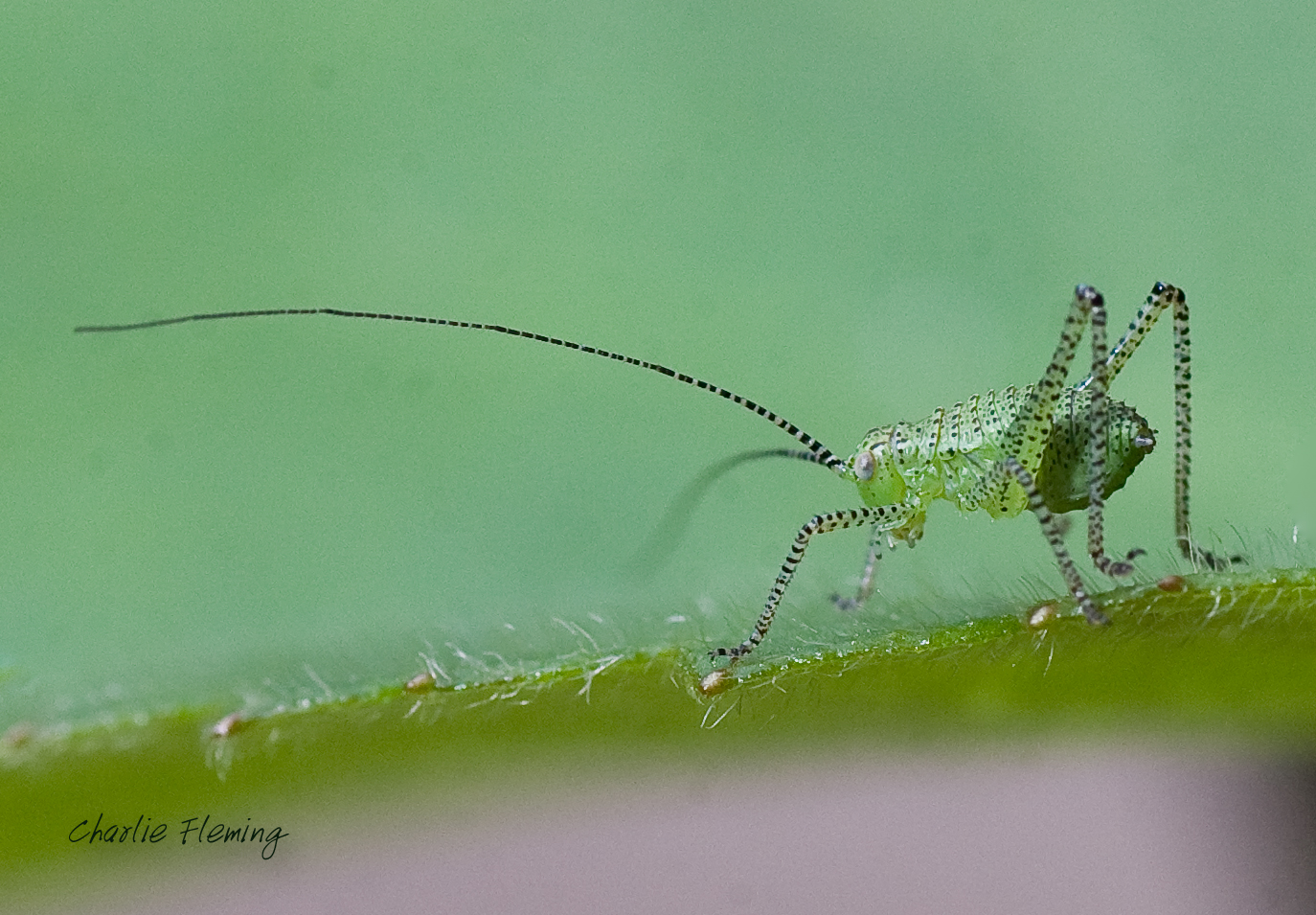
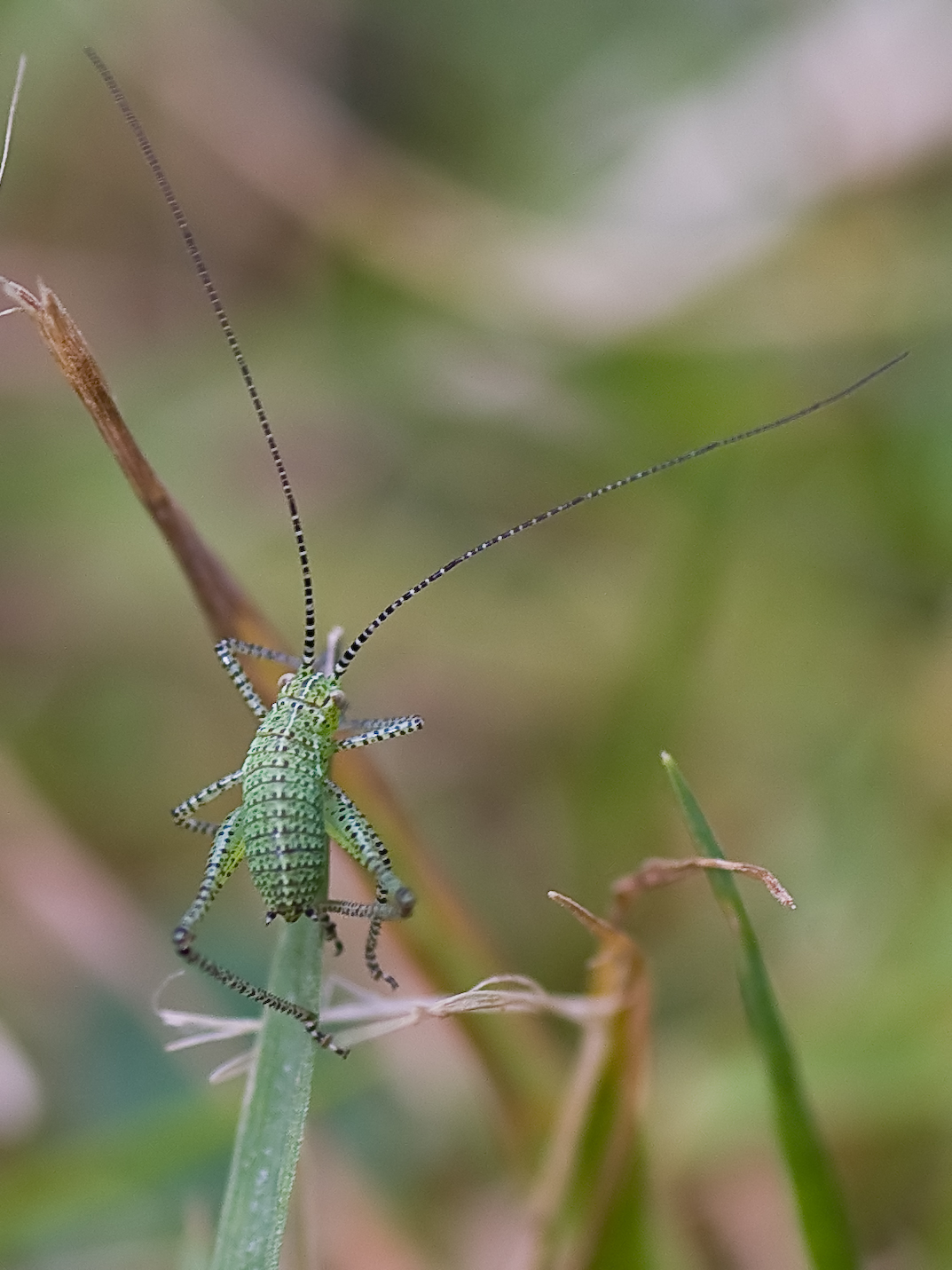
A completely flightless, very long-legged cricket, the “Speckled Bush Cricket” is virtually wingless, apart from the tiny brown flaps on the top of the male’s body. It is bright green, conspicuously spotted with very dark red speckles. Its song is very high-pitched and barely audible to the human ear.
It is well camouflaged among vegetation and usually only seen as it hops to bright outdoor lights or windows at night. It lives on well structured vegetation, tall grasses and shrubs, being found as an adult from mid-July through to the autumn. Eggs are laid in bark and the young nymphs hatch the following spring. A common species throughout southern England and the East Midlands, it is absent from the North.
Young hatch from mid-May onwards and mature through 6 larval stages to adult, with about one week for each state and one week for the adult to become sexually mature. Males appear to have a shorter adult life than females. Females can still be around in early November but we do not believe that any survive the winter. I last saw them in my garden on the 20th May. I can say that the ones seen today, several in fact were slightly larger than those 2 weeks ago. I find them very photogenic and am looking forward to seeing adults later in the summer.
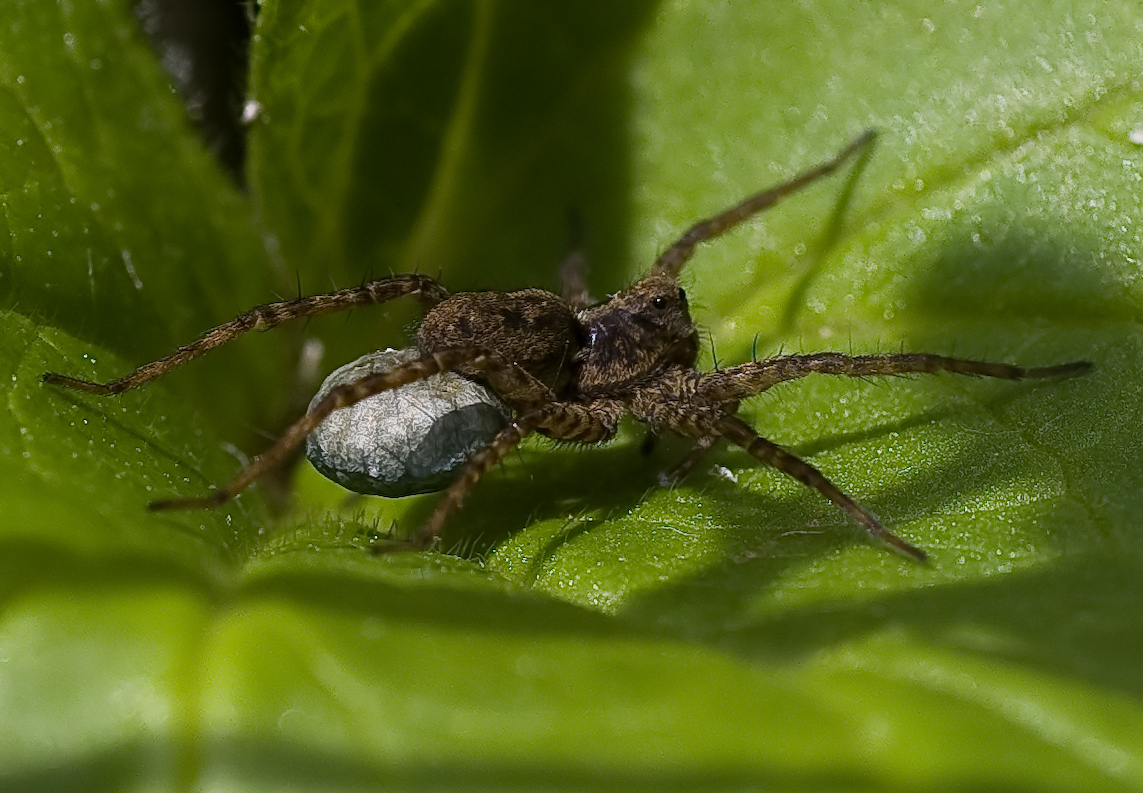
This Wolf Spider sp. is very interesting. You can clearly see that it has what seems to be a sack protruding from its backside. This is in fact an egg sack. The female makes it from her spineret and lays her eggs in the sack which she then attaches to the spineret and carries around with her. After a week, the babies hatch and climb on to the mothers back and she continues to carry them with her. This is a reasonably small spider, around 5 mm long, not including the legs and therefore the tiny spiders on her back are not immediately noticeable but you can see them very clearly in the photo below.
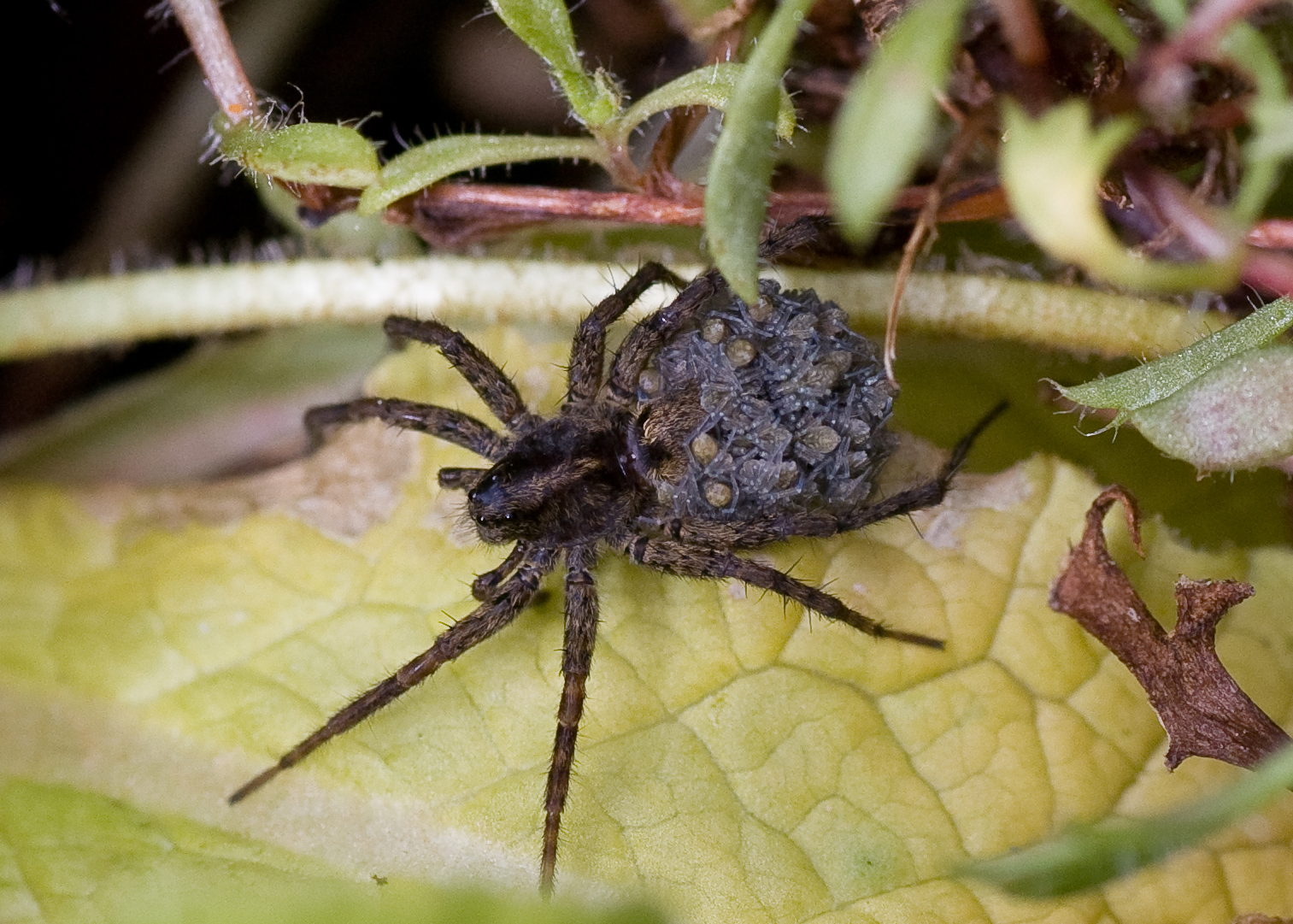
There are several theories as to the name of this spider which does not build a web, but in stead either chases down or ambushes it’s prey, like a wolf in fact. My theory is that they are very hairy when you look closely. They look like mini terantula. Also look at the size of the “main” pair of eyes which are very animal like and massive in comparison to the rest of the body. Eyesight is obviously an important faculty for a hunter. I will be having a close look for them again.
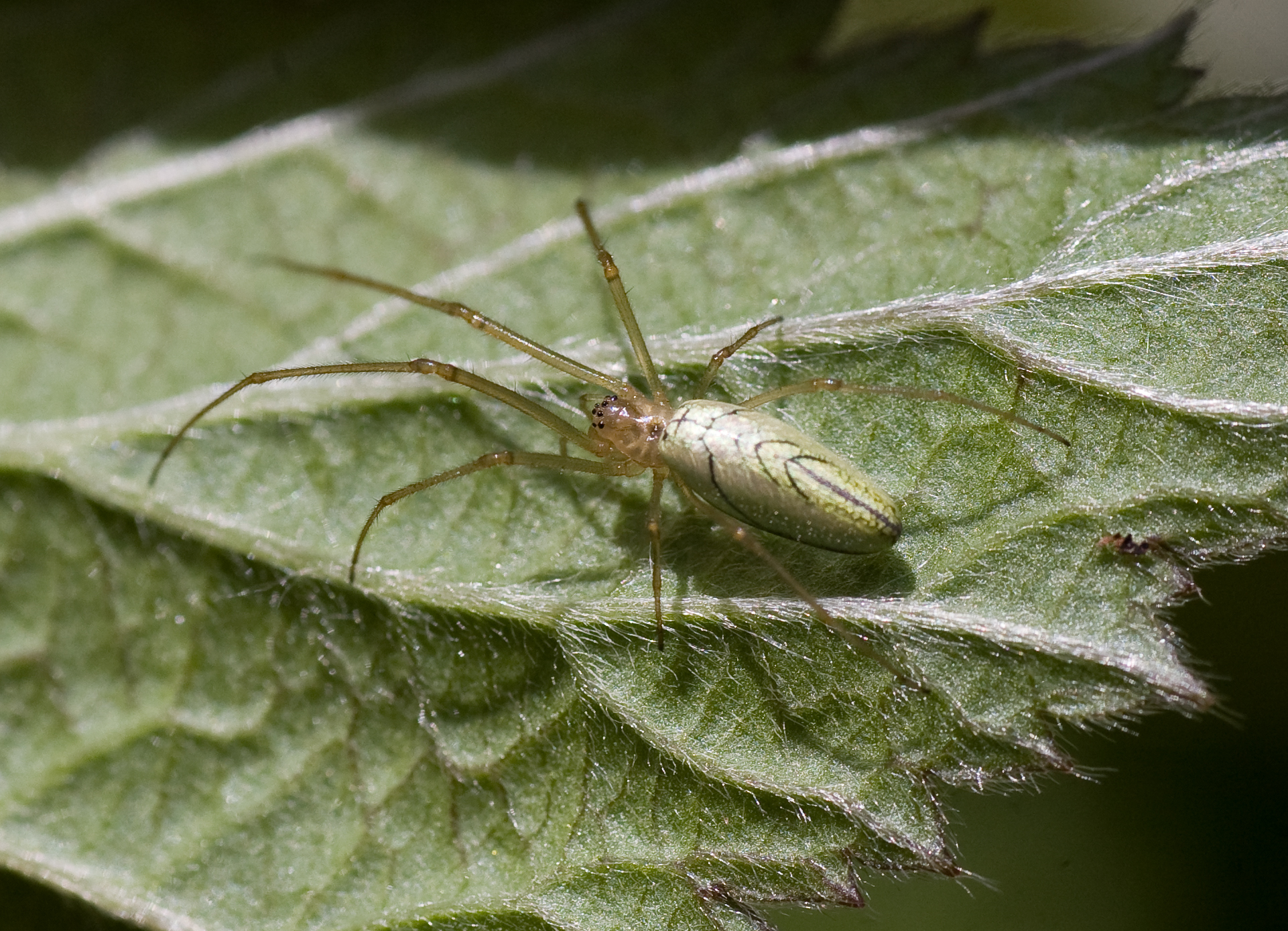
I have an idea that this spider is a cucumber spider, named after it’s colour but I am checking this before we go public with it! , I will be confirming this information as soon as I have it but it was one of 4 different species seen today in the garden.
I also am pretty sure that this one is a Crab Spider again not sure of the scientific name but I do feel that if the blog is to have anything serious to say then this is very important and I will be giving it a scientific name in due course.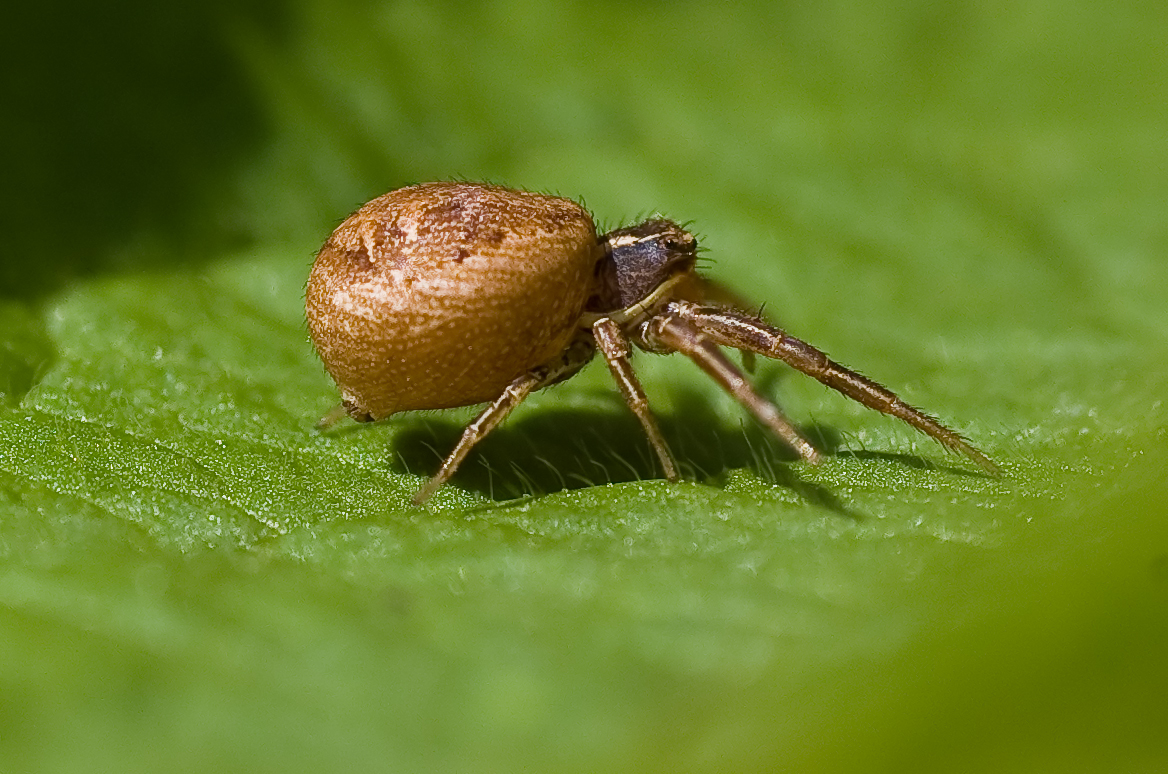
Again this spider has large eyes and would indicate that it is also a hunter/ambush feeder. I see this species in my garden every year and have never seen it with a web so pretty sure of my assumptions. If you look at the Cucumber above you can see that eyes are hard to see which would indicate that this is a web builder and I can confirm that this is a fact.
Other species in the garden today were 4 different Hoverflies and a Painted Lady Butterfly, the first for a week. I really enjoy being able to step in to the garden and find interesting insects and arachnids to photograph. This is totally different than trecking on to Dartmoor and finding relatively exotic birds like the Cuckoo. In the garden there are discoveries to be made and I think finding the egg/baby carrying Wolves is proof of that for sure!
 Wildlife in a Suburban Garden
Leave a comment