
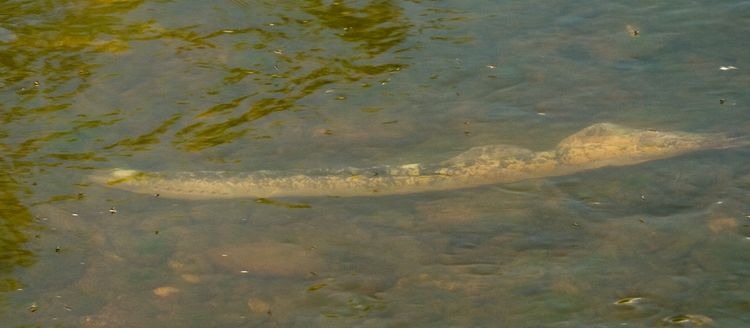
Out yesterday at the Sand Martin colony as blogged here I had an interesting and great sighting. I stood talking to a dog walker who's Staffordshire Bull Terrier had disturbed my photographic session. We were just casually glancing in to the water when a large, odd looking fish appeared in the shallows. At first I thought it was a Salmon and then an eel but after just a few seconds I realised that it was a Sea Lamprey. It was large, at least 3ft long and it was very blotchy in appearance with a strangely large and odd shaped tail. here is a description that I downloaded.
• Lampreys are among the most primitive of all living vertebrate animals. They belong to a group known as Agnatha – literally ‘jawless fishes.’
• They only have one nostril – on the top of their head!
• The lamprey’s saliva contains an anti-coagulant that keeps a wound open so that it can continue to feast on the blood of its host.
• The male sea lamprey releases a powerful sex-hormone that females find irresistible. They can detect it up to 65 metres away. While insects are known to emit pheromones to attract mates, the lamprey is the first vertebrate creature to use a similar chemical ‘come-on.’
And this from Wikipedia:
"The sea lamprey (Petromyzon marinus) is a parasitic lamprey (a kind of jawless fish) found on the Atlantic coasts of Europe and North America, in the western Mediterranean Sea, and in the Great Lakes. It is brown or gray on its back and white or gray on the underside and can grow to be up to 90 cm (35.5 in) long. Sea lampreys prey on a wide variety of fish. The lamprey uses its suction-cup like mouth to attach itself to the skin of a fish and rasps away tissue with its sharp probing tongue and teeth. Secretions in the lamprey's mouth prevent the victim's blood from clotting. Victims typically die from blood loss or infection."
My photo shows the 7 gill holes and the large tail as mentioned. (The head is to the left). It was interesting to note that it disturbed the river bed and sent up "clouds" of muddy water. I took this is an indication of spawning activity as they are known to move large rocks on the river bed to get to the sand beneath where they then lay their eggs.
 Wildlife in a Suburban Garden
Leave a comment