
The Whinchat is one of those birds that you feel you ought to see more often but the truth of the matter is, they are not that common and you have to be in the right habitat to see them Even then you need to be quite vigilant and know where to look. But with most species once you get used to what to look out for then they are not too hard to find. We live close to the famous Dartmoor National Park and yesterday evening I went specifically to go and find one or two. As you can see from the photo I was successful but only just.
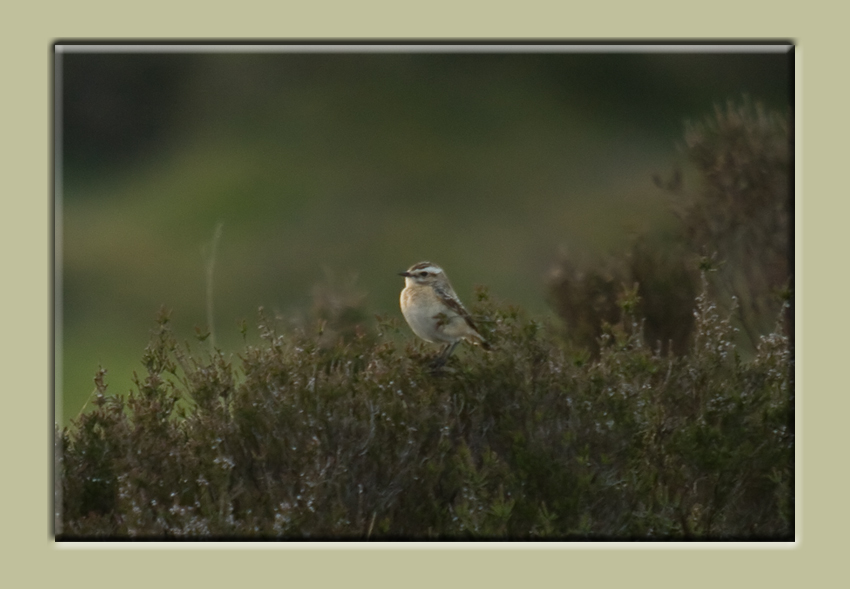
As dusk approached and after a couple of hours wandering, I had watched, in the distance, Green Woodpecker, Cuckoo, Sparrowhawk and a bit closer, Stonechat. There were frustrating songs from Whitethroat, Wren, Willow Warbler, Reed Bunting and an occasional song that I was not sure of. Then as I made my way back up from Sousons Plantation I heard an interesting song, have a listen to one here. I had been hearing it all day as it happens but it had kind of just "mashed" in to the background. The sun was low now and caught the white stripe of the bird and I knew, in fact I said out loud……. Whinchat. I took this photo quickly before I tried to get closer. This one is a male and as I took a few steps forward the female who had been closer to me all along took to the air. This post is really intended to help you locate your own Whinchat and I will use my Dartmoor experience as an example. So, this part of Dartmoor is at the bottom of a valley, it is sheltered and the grass is closely cropped by sheep and ponies but as you can see in the photo there are low heathers and the occasional small Hawthorn or Rowan tree dotted amongst the heathers. The Whinchats that I have seen have always been perched on the tops of Heathers very prominently. This one did not allow me to approach but last year they were much more confiding and not been too quick to fly off but as it happened this was because they had newly fledged youngsters nearby and they were reluctant to leave them.
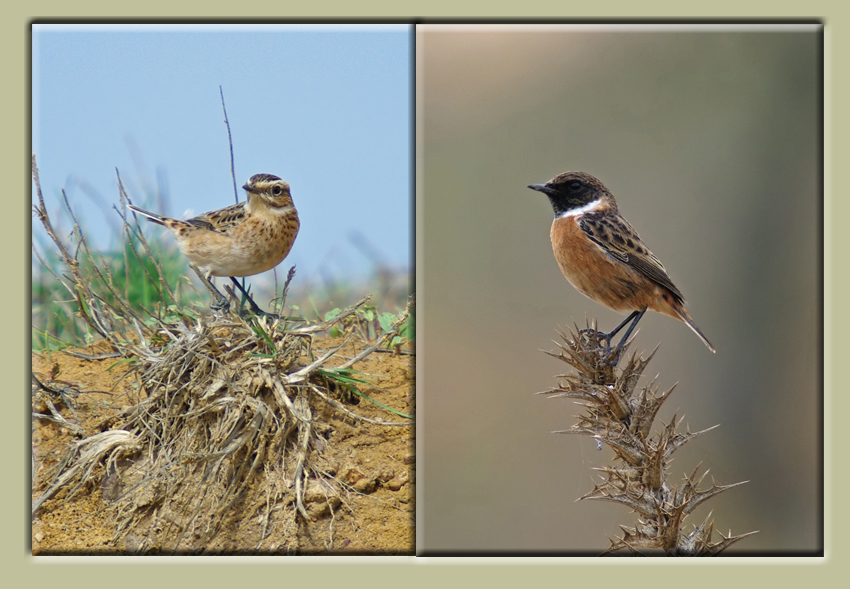
I would say that if you see a female Stonechat and you think it may be a female Whinchat then look for any stripe that goes way way back and if there is any doubt whatsoever then it is a Stonechat for sure. Once you see a Whinchat then there is no doubt whatsoever. Also if you look at the RSPB images on their Web Site here you will see that they have an illustration showing the Stonechat and Whinchat having the same basic reddish breast. This is so totally misleading and you should ignore it. Their illustration shows some kind of different species totally unlike any Whinchat I have ever seen either in photographs or real life. (How weird that the RSPB could get something such as this so wrong). At Sousons/Warren House you need to look up on to the heather covered shallow slopes either side of the path and any bird perched, singing on the tops of the heather will be either Whinchat, Stonechat or Meadow Pipit. There are several pairs of Stonechats in this are and my experience is that you will see the Stonechat before the Whinchats show themselves but just keep looking, learn the song by listening to the sound clip before you go out.
 Wildlife in a Suburban Garden
Leave a comment