
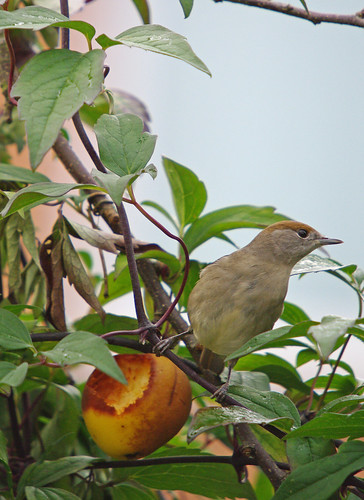
Well what about this little beauty? It was lunchtime and there had been quite a lot of activity in the garden with Coal Tits and Blue Tits being joined by a Dunnock and Robin, all now getting really used to the idea that my garden is a good place to find food. From my kitchen window a little movement caught my attention and I expected to see one of the Tits moving through the cotoneaster towards the sunflower feeder. Imagine my pleasure when I saw a lovely bright and attractive male Blackcap. The first of the year. So I rushed up to the bathroom where I hoped to get a shot but there was no sign of him now. I waited and had a look at the activity further down the garden and was thrilled to see him again feeding on a the remains of a solitary apple hanging from the tree and protected by the leaves of clematis climbing through the branches. I quickly hurried to the garden shed where I positioned myself in the doorway behind some cam netting. Now with the lens focused in onto the apple I waited for 10 minutes or so. Imagine my excitement when something flew in and I focused on the bird above ………. a female of the species. I took lots of photographs of the bird who was intent on feeding on the fruit. I had wonderful views and as you can see got these fabulous photos.
Blackcaps are one of the Warbler species that are known to over-winter in southern Britain. I am not sure if the individuals that we have here in the winter are Northern birds who have moved here to replace our breeding population but I would hazard a guess that this is the case. I didn’t manage a good photo of the male but now they are around and they know there is a food source in the garden I am sure that they will be back. This will give me an opportunity to get some good shots of the male. I can’t wait!
Blackcaps are one of the Warbler species that are known to over-winter in southern Britain. I am not sure if the individuals that we have here in the winter are Northern birds who have moved here to replace our breeding population but I would hazard a guess that this is the case. I didn’t manage a good photo of the male but now they are around and they know there is a food source in the garden I am sure that they will be back. This will give me an opportunity to get some good shots of the male. I can’t wait!
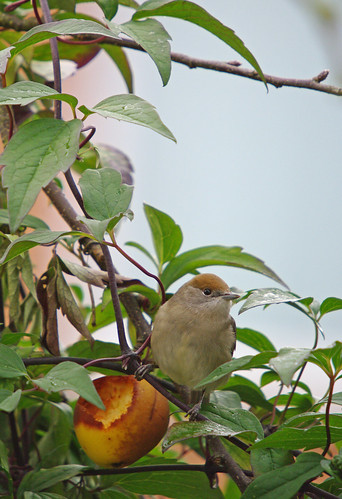
This is one a particularly like.

In some areas of the Mediterranean, the blackcap is considered a delicacy. An estimated 900 million of these migrant birds are illegally trapped and eaten each year.
It also appears that there is much, much more to this species than first meets the eye. Read this article here to find out more about migration. It seems our birds are German or Austrian birds.
 Wildlife in a Suburban Garden
Leave a comment